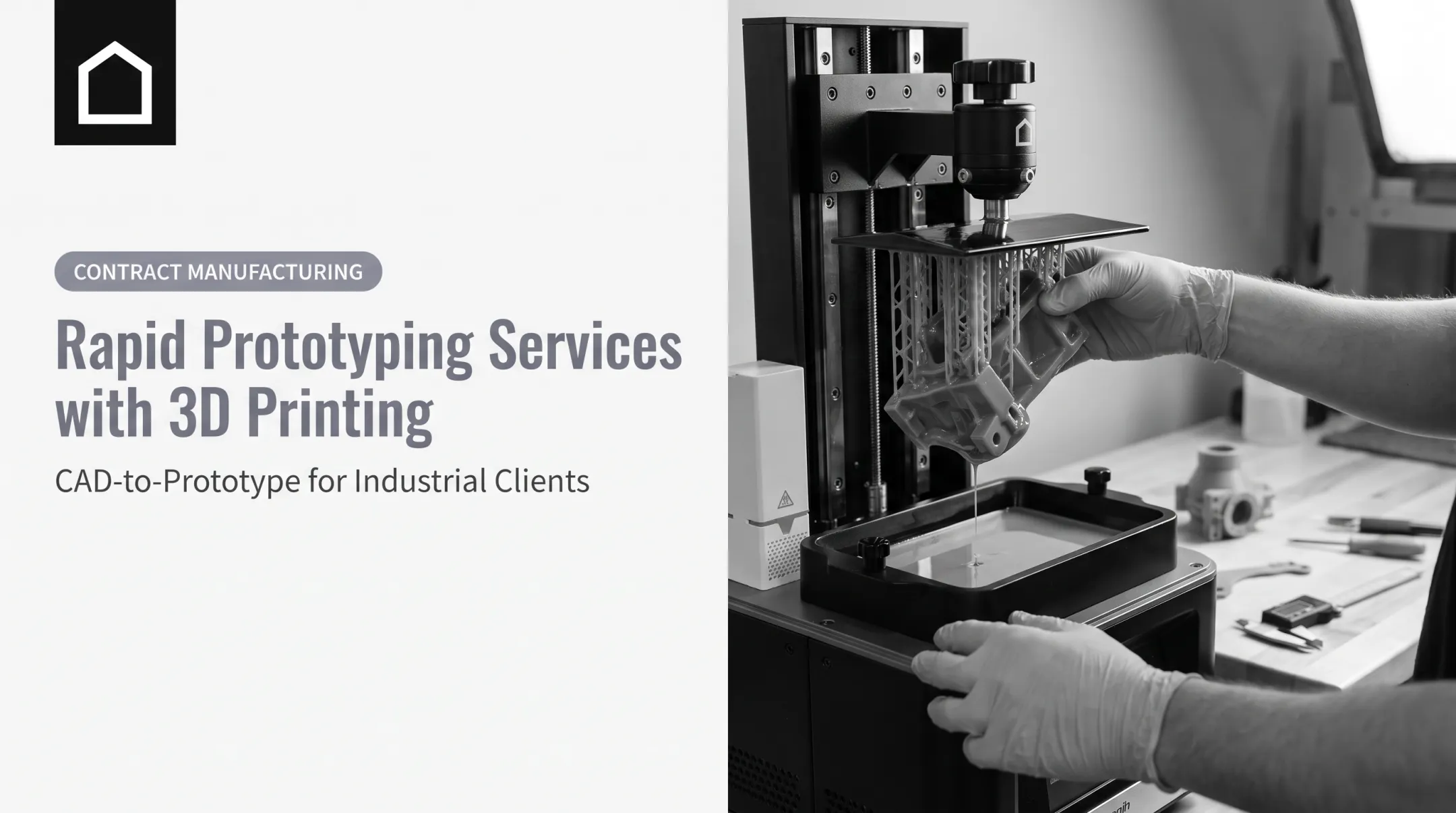

Rapid 3D prototyping flips that timeline. It converts a CAD file into a physical model without touching a single piece of tooling, often in hours. Formlabs reports that teams can print overnight, test the next morning, and revise again the same week.
This process solves three expensive problems: tooling costs paid before a design is proven, vendor cycles that stall momentum, and design flaws discovered only after production has started. Below, we'll cover what rapid 3D prototyping actually is, how the process works, which materials and prototype types matter, and where it delivers the most value.
Key Takeaways
- Rapid 3D prototyping turns digital CAD files into physical models using additive manufacturing, no tooling required
- It shortens development timelines and catches design flaws early across automotive, medical, military, and electronics projects
- Matching the right printing technology, material, and prototype fidelity to your goal determines whether feedback is useful
- A one-stop manufacturer like Finine Design and Manufacturing carries projects from prototype through full production without a vendor handoff
What Is Rapid 3D Prototyping?
Rapid 3D prototyping is the process of using additive manufacturing, more commonly called 3D printing, to quickly turn a CAD file into a physical object you can hold, test, and evaluate. It's a product-development strategy built around speed and iteration.
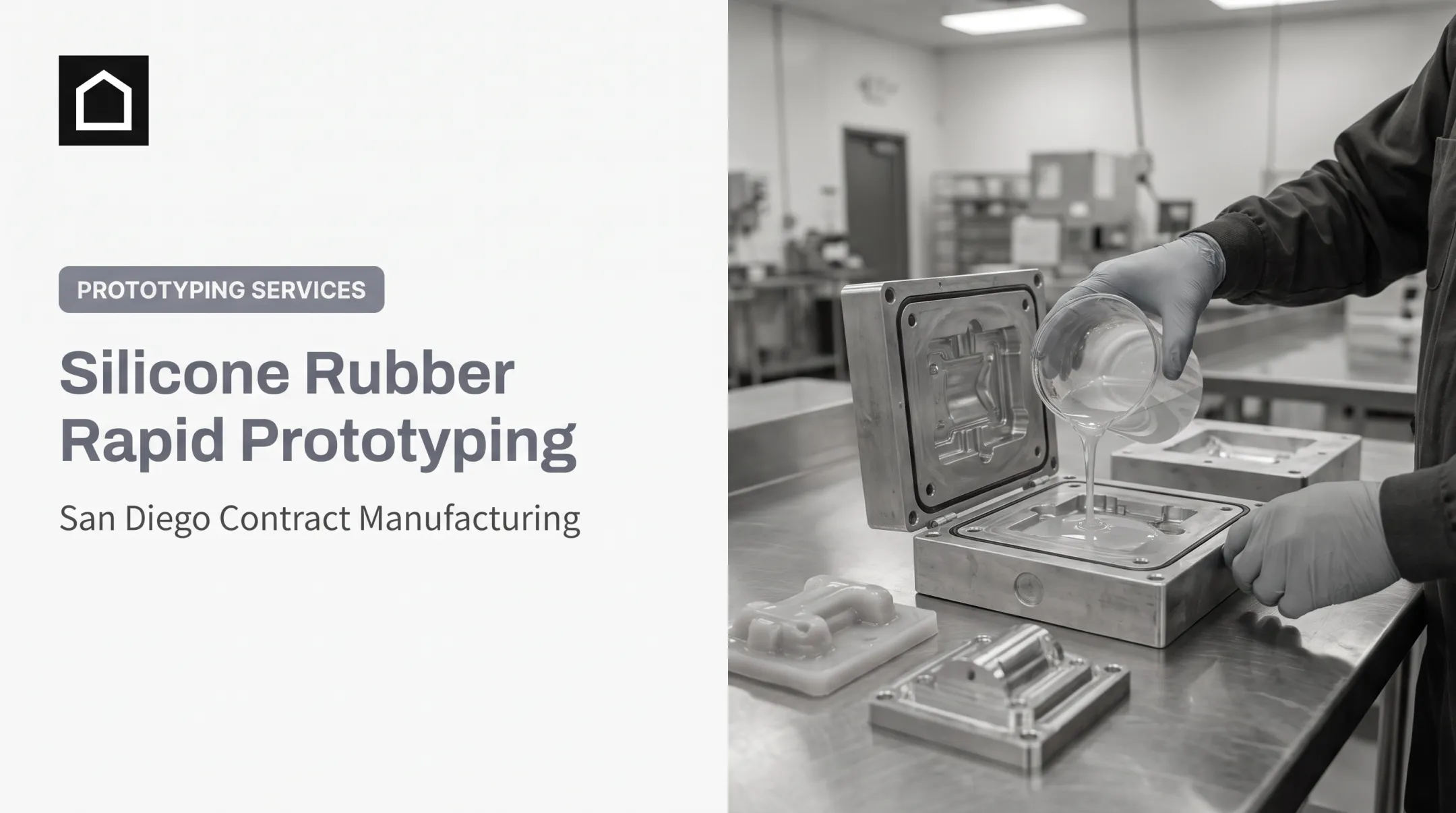
Rapid prototyping and 3D printing aren't the same thing. Rapid prototyping is the broader goal: validate a design quickly and cheaply before committing to production. 3D printing is one of the specific technologies used to hit that goal, alongside methods like CNC machining and urethane casting.
This matters because traditional prototyping methods, such as machining a part from a block of material or hand-building a model, require setup time, skilled labor per piece, and often dedicated tooling. Additive manufacturing skips that setup entirely.
Why it's faster:
- Stratasys documents a case where a manufacturer cut prototyping time by up to 69%, producing parts in a few hours instead of days
- Jabil reports completing 19 design iterations in the time a traditional method would need for just one
Speed aside, none of it works without a solid CAD model underneath. The digital design is the foundation. If the geometry is off, the printed prototype inherits every flaw, so accurate CAD work upfront saves reprint cycles later.
How Rapid 3D Prototyping Works: The Step-by-Step Process
Getting from idea to tested prototype follows a consistent loop, regardless of industry.
- Define the CAD design and objectives. Decide what you're testing: form (does it look right), fit (does it assemble correctly), or function (does it perform under load).
- Select the printing technology. FDM, SLA, and SLS each solve different problems, more on that below.
- Choose materials aligned to your goal. A visual mockup for a client meeting doesn't need the same material as a part getting stress-tested.
- Print and post-process. The part builds layer by layer, then gets sanded, cured, or finished depending on the technology used.
- Test, gather feedback, and iterate. This is where the real value shows up — real-world testing feeds directly back into the next design revision.
The iterative loop in step five is what separates "rapid" from conventional prototyping. A traditional vendor cycle might take two to three weeks per revision. A rapid prototyping loop can turn around in a day or two, letting a team run through dozens of design revisions in the time a traditional vendor would need for two or three.

Finine Design and Manufacturing runs this exact loop in-house, from CAD modeling through 3D printing and finishing, so clients in automotive, military, consumer electronics, and medical fields can iterate without waiting on multiple outside vendors.
Materials and Technologies Used in Rapid 3D Prototyping
Not every 3D printing method serves the same purpose. Choosing the wrong one wastes both time and material.
| Technology | Best for | Trade-off |
|---|---|---|
| FDM | Durable, functional thermoplastic parts | Lower detail on complex geometry; visible layer lines |
| SLA | Fine detail, smooth finish, dimensional accuracy | Requires washing, support removal, UV curing |
| SLS | Strong, complex nylon parts without supports | Powder needs cooling; finish varies by material |
Common materials and what they're good for:
- PLA — stiff and affordable, but low impact and heat resistance
- ABS (specifically Stratasys ABS-M30) — stronger grade suited to functional prototyping
- PETG — solid resistance to water-based chemicals and mild acids
- Nylon (SLS) — lightweight, strong, and stable against heat, chemicals, and UV exposure
- SLA resins — range from soft to hard, with specialty formulations for high-temperature or clear applications

Regulated industries add another layer. Medical and dental work often needs biocompatibility testing under FDA guidance tied to ISO 10993-1. Any change to material chemistry, geometry, or manufacturing process can trigger a new evaluation requirement, so a prototype material isn't automatically cleared for patient contact.
Finine Design and Manufacturing works across these material and process options daily, guiding automotive, military, consumer electronics, and dental/orthopedic clients toward the right choice for their functional and regulatory needs.
The Four Main Types of Prototypes
Understanding Prototype Fidelity Levels
Not every prototype needs to look or function like the final product. Matching fidelity to your development stage avoids wasted time on details that don't matter yet, and it avoids under-testing details that do.
Proof-of-Concept Prototypes
These test whether the core idea works at all. Aesthetics don't matter here. A proof-of-concept prototype might be rough, single-material, and built purely to answer one question: does this mechanism do what we think it does?
Visual/Presentation Prototypes
Built for stakeholder buy-in and ergonomics checks. These prototypes look like the final product, even if they don't function like it. They're common in early client presentations or investor pitches, where appearance and feel matter more than mechanical performance.
Functional Prototypes
These test mechanical performance, durability, and real-world stress. A functional prototype might look nothing like the final design but must perform the same way under load, heat, or repeated use.
Production-Ready Prototypes
The closest thing to the final manufactured product. These validate fit, function, and manufacturability together, serving as the last checkpoint before committing to full-scale production tooling.
Finine Design and Manufacturing builds all four types in-house, moving projects from rough proof-of-concept prints to production-ready parts using 3D printing, CNC machining, and urethane casting under one roof. Matching the right process to each fidelity level is:
- Proof-of-concept: single-material 3D printing for fast mechanism testing
- Visual/presentation: cosmetic finishing and painting for client-ready looks
- Functional: CNC-machined or cast parts built to survive real-world stress
- Production-ready: injection-molded or tooled parts validated for manufacturability

Benefits of Rapid 3D Prototyping for Product Development
Rapid prototyping delivers measurable advantages across the product development cycle:
- Faster time-to-market: Quick iteration cycles compress months of back-and-forth into weeks, with every design change tested almost immediately instead of waiting on a vendor's queue.
- Cost savings: According to a Jabil case study, a part costing $20 to produce traditionally dropped to under $6 using additive manufacturing, and came out 70% lighter. Tooling-free prototyping avoids sinking capital into a mold before the design is proven.
- Design flexibility: Complex geometries that would need custom tooling for each variation can be printed directly from updated CAD files. Testing five design variations costs five print runs, not five sets of tooling.
- Risk reduction: Catching a design flaw at the prototype stage costs a reprint. Catching it after tooling is cut costs weeks and thousands of dollars.

Companies that keep CAD modeling, 3D printing, CNC machining, and casting under one roof help clients move through these iterations without switching vendors between each stage. Finine Design and Manufacturing operates this way, offering CAD refinement, 3D printing, CNC machining, urethane casting, and injection molding from one San Diego facility. That means a prototype that starts as a rough proof-of-concept can move toward a production-ready part without a new vendor relationship at every stage.
Industries That Rely on Rapid 3D Prototyping
Medical, dental, and orthopedic. Precision matters most here, whether it's a surgical tool mockup or a patient-specific model. Prototypes for medical devices can often move from design file to physical part in under two hours instead of days or weeks. Finine Design and Manufacturing has built specialized expertise in dental and orthopedic product development, an area where fit and function errors carry real consequences.
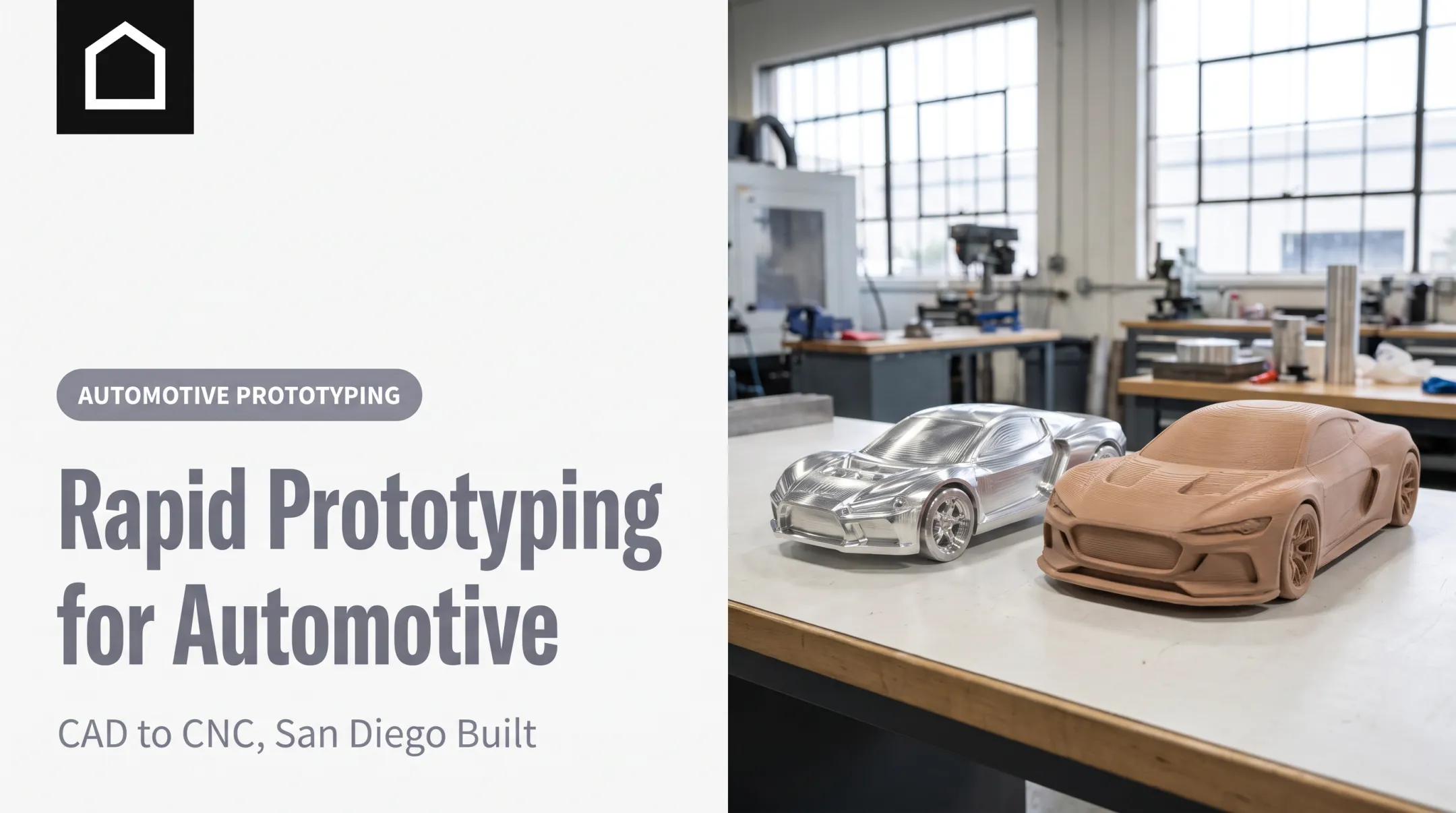
Automotive and military/defense. Both sectors demand durable, functional components tested under real conditions. Automotive design teams use 3D printing to prototype parts like badge lettering in a matter of hours. On the defense side, the US Army's Picatinny Arsenal makerspace runs more than 50 printers to support design, prototyping, and manufacturing.
Consumer electronics. Product cycles here move fast. Housings, buttons, and ergonomic fit need constant iteration, and rapid prototyping keeps development pace matched to market demand.
These industries share a common thread: tight tolerances, regulatory or performance pressure, and no room for slow iteration cycles. That's why sectors like these benefit most from a single partner handling design, prototyping, and production:
- Medical/dental/orthopedic — patient-specific fit and regulatory scrutiny demand precision at every stage
- Automotive — functional parts must survive real-world stress testing before tooling investment
- Military/defense — rapid iteration supports mission-critical design changes without long lead times
- Consumer electronics — fast product cycles require constant ergonomic and housing refinement
Frequently Asked Questions
How much does it cost to 3D print a prototype?
Cost depends on part size, material, complexity, and the printing technology used. There's no fixed universal price, so requesting a project-specific quote from a manufacturer like Finine Design and Manufacturing is the most accurate way to budget.
What is rapid prototyping?
Rapid prototyping is the process of quickly building physical models from digital designs so teams can test, refine, and validate before committing to production.
Is rapid prototyping the same as 3D printing?
No. 3D printing is one specific technology used within the broader rapid prototyping process, alongside methods like CNC machining and urethane casting.
What is a 3D prototype?
A 3D prototype is a physical model created from a digital design, used to evaluate appearance, fit, or function before full manufacturing begins.
What are the four main types of prototypes?
The four types are proof-of-concept (tests the core idea), visual (tests appearance), functional (tests performance), and production-ready (final validation before manufacturing). Each serves a different stage of development.