
For global OEMs, that scale translates into real advantages: lower per-unit costs, mature supply chains, and faster access to Southeast Asian markets. Malaysia now commands 13% of the global market for semiconductor packaging, assembly, and testing — a figure MIDA confirmed in September 2024, cementing the country's position well beyond a low-cost alternative.
This article breaks down the top EMS providers operating in Malaysia, what separates them, and when a US-based partner might actually serve your project better.
TL;DR
- EMS covers PCBA, system assembly, and box build; Malaysia is a global leader
- Penang, Selangor, and Johor form the core manufacturing corridor
- Leading providers include Jabil, Flex, Celestica, VS Industry, and ATA IMS/WaveFront
- ISO 9001 and ISO 13485 certifications outweigh headline pricing
- Malaysia fits high-volume runs; prototyping and low-volume work often suit a US partner
Overview of Electronics Manufacturing Services (EMS) in Malaysia
EMS providers handle the physical side of electronics production: printed circuit board assembly (PCBA), full system integration, cable assembly, injection moulding, and complete box-build manufacturing. For OEMs, outsourcing this work means avoiding the capital expense of building factories while tapping into specialised expertise.
Malaysia's manufacturing strength concentrates in three states:
- Penang — the "Silicon Valley of the East," with RM31 billion (about $7.5 billion) in investment; 88% tied to electronics, equipment, and medical technology (SEMI)
- Selangor — home to multiple Flex facilities and broader industrial infrastructure
- Johor — headquarters of VS Industry and ATA IMS, plus Celestica and Flex operations
Together, these states give Malaysia the density and specialisation needed to support industrial-scale electronics production. Below is a closer look at who runs that production.

Top Electronics Manufacturing Services Providers in Malaysia
Ranking EMS providers isn't just about revenue. We weighed factory footprint, industry certifications, and how diverse each company's client base is across sectors.
Jabil Inc.
Jabil traces back to 1966 and has grown into a manufacturing giant, posting $29.8 billion in revenue for FY2025. In Malaysia, the company operates across multiple Penang and Kedah sites, including Batu Kawan, Bayan Lepas, Kulim, and Sungai Petani.
What sets Jabil apart:
- Massive scale with diversified end markets, from healthcare to industrial equipment
- Advanced automation capabilities backed by 9,000+ engineers supporting prototype-to-production work
- Deep bench of manufacturing expertise across multiple sectors, reducing single-industry risk
| Metric | Detail |
|---|---|
| Revenue | $29.8B (FY2025) |
| Malaysia Locations | Batu Kawan, Kulim, Sungai Petani, Penang facilities |
| Key Specialisation | Large-scale PCBA, system integration |

Flex Ltd.
Founded in 1969 in Silicon Valley by Joe and Barbara-Ann McKenzie, Flex reported $27.9 billion in revenue for FY2026. It runs the largest confirmed Malaysia footprint among major EMS players — 12 facilities spread across Penang, Selangor, and Johor.
Flex's differentiators:
- Broadest geographic spread within Malaysia, covering Batu Kawan, Senai, and multiple Penang sites
- Vertical integration spanning design, manufacturing, and logistics
- Strong presence in consumer, industrial, and healthcare product categories
| Metric | Detail |
|---|---|
| Revenue | $27.9B (FY2026) |
| Malaysia Locations | Penang, Selangor, Johor (12 facilities) |
| Key Specialisation | End-to-end EMS, supply chain management |
Celestica Inc.
Celestica was incorporated in 1994 as an IBM subsidiary and now reports $12.39 billion in FY2025 revenue. In Malaysia, it operates across Johor and Kulim, with additional Penang sites handling platform and cloud operations.
Why it stands out:
- Specialises in complex, high-mix electronics for aerospace and communications clients
- Its Johor AMS operation is explicitly built for high-speed, high-volume manufacturing
- Strong track record with technically demanding, low-tolerance-for-error products
| Metric | Detail |
|---|---|
| Revenue | $12.39B (FY2025) |
| Malaysia Locations | Johor, Kulim, Penang |
| Key Specialisation | High-complexity assembly |
VS Industry
Founded in 1982 and headquartered in Senai, Johor, VS Industry describes itself as one of Malaysia's largest homegrown EMS providers — its FY2025 annual report cites a global rank of 32 and third place within ASEAN.
What makes VS different:
- Vertical integration from mould design through supply chain and logistics
- Services span plastic-injection mould fabrication, PCB production, and automated assembly
- Client base includes what the company describes as "world-renowned customers" across Europe, Japan, and the US
| Metric | Detail |
|---|---|
| Founded | 1982 |
| Locations | Malaysia, China, Indonesia, Vietnam |
| Key Specialisation | Full-service EMS, mould design |

ATA IMS (WaveFront)
Established in 1972 and headquartered in Johor, ATA IMS — now operating under the WaveFront name — positions itself as a vertically integrated, one-stop EMS provider. The company's current site claims a global rank of 23 among EMS providers, though this figure isn't repeated in its FY2025 annual report.
Its focus areas:
- Consumer electronics, medical devices, and LED lighting solutions
- Vertically integrated operations from plastic injection through final assembly
| Metric | Detail |
|---|---|
| Revenue | RM273 million (FY2025) |
| Founded | 1972 |
| Locations | Malaysia, India |
| Key Specialisation | Consumer electronics, medical devices |
How We Chose the Best EMS Providers
Many EMS buyers chase the lowest quoted unit cost, then get burned by quality slippage, missed timelines, or hidden logistics fees. A cheaper hourly rate means nothing if defect rates climb or a shipment slips six weeks.
Instead, we weighed four factors tied directly to business outcomes:
- Certifications — ISO 9001 for general quality management, ISO 13485 for medical-device work
- Factory capacity — confirmed facility counts, not just marketing claims
- Client diversity — multi-industry books signal resilience when one sector slows
- Geographic footprint — access to Malaysian ports and supplier networks shortens lead times
When a US-Based Manufacturing Partner Makes More Sense
Malaysia's EMS providers excel at high-volume, cost-optimized production. But if you're still refining a design, that scale can work against you. Large-volume factories aren't built for rapid iteration, small batch runs, or the back-and-forth collaboration that early-stage product development demands.
This is where a domestic partner fits in. Finine Design and Manufacturing, based in San Diego, operates as a one-stop shop for concept-to-production work, offering:
- CAD modeling and design refinement
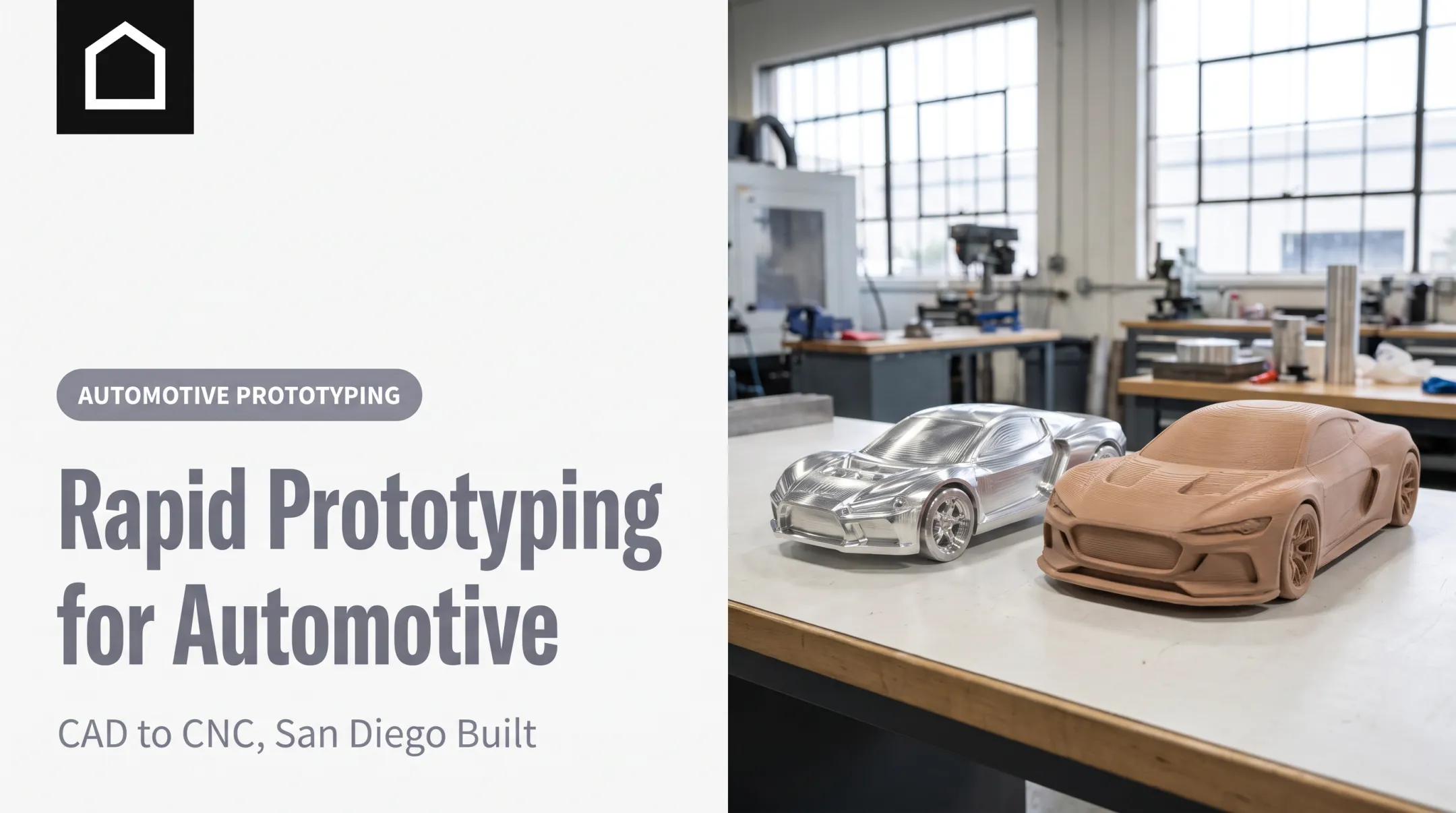
- 3D printing and CNC machining for prototypes
- Urethane casting for short production runs
- Injection molding for scaling into repeatable production
- Production painting and cosmetic/graphic finishing
Finine serves clients across automotive, military, consumer electronics, and medical sectors — with particular depth in dental and orthopedic sales tools and educational products. Its urethane casting process, for example, sits between 3D printing and full injection molding. Clients can validate a design in production-representative materials before committing to overseas tooling.
A hybrid approach often makes the most sense: use a domestic partner for prototyping and low-volume validation, then transition to a Malaysian EMS provider once the design is locked and volumes justify offshore tooling costs.
Conclusion
Choosing the right EMS partner in Malaysia comes down to matching production scale, certifications, and industry focus to your specific goals — not just chasing the lowest quote. Before signing on with any provider, evaluate their track record on scalability, ongoing quality performance, and total landed cost, not just the initial unit price.
If your project still needs fast-turnaround domestic design work, prototyping, or low-volume production before it's ready for offshore scale, start with a US partner. Finine Design and Manufacturing provides concept-to-production support right here in the US.
Frequently Asked Questions
What electronics does Malaysia produce?
Malaysia's electronics sector centres on four subsectors: electronic components, industrial electronics, consumer electronics, and electrical products. Semiconductors and packaging services also make up a major share of output.
Where in Malaysia are most EMS factories located?
Penang, Selangor, and Johor host the bulk of the country's EMS facilities. Penang alone has attracted roughly $7.5 billion in investment, with the majority tied to electronics and medical technology.
Why do global companies choose Malaysia for electronics manufacturing?
Companies cite a skilled multilingual workforce, mature industrial infrastructure, and government incentives like Pioneer Status tax exemptions. Its strategic Southeast Asian location also shortens shipping times to major markets.
What certifications should I look for in a Malaysian EMS provider?
Look for ISO 9001 as a baseline quality-management certification across any sector. If you're producing medical devices, ISO 13485 and RoHS compliance are essential additions.
How does Malaysia compare to China for electronics manufacturing?
Malaysia is frequently used as a "China+1" strategy, reducing geopolitical and supply-chain concentration risk. Labour costs tend to run higher than China's, but many companies view the diversification as worth the tradeoff.
Is Malaysia a good fit for low-volume or prototype electronics production?
Malaysia's EMS ecosystem is generally optimised for high-volume, repeatable runs rather than rapid prototyping. Companies still iterating on a design often get faster turnaround and lower minimums from a domestic manufacturing partner, then transfer volume production to Malaysia once the design is stable.