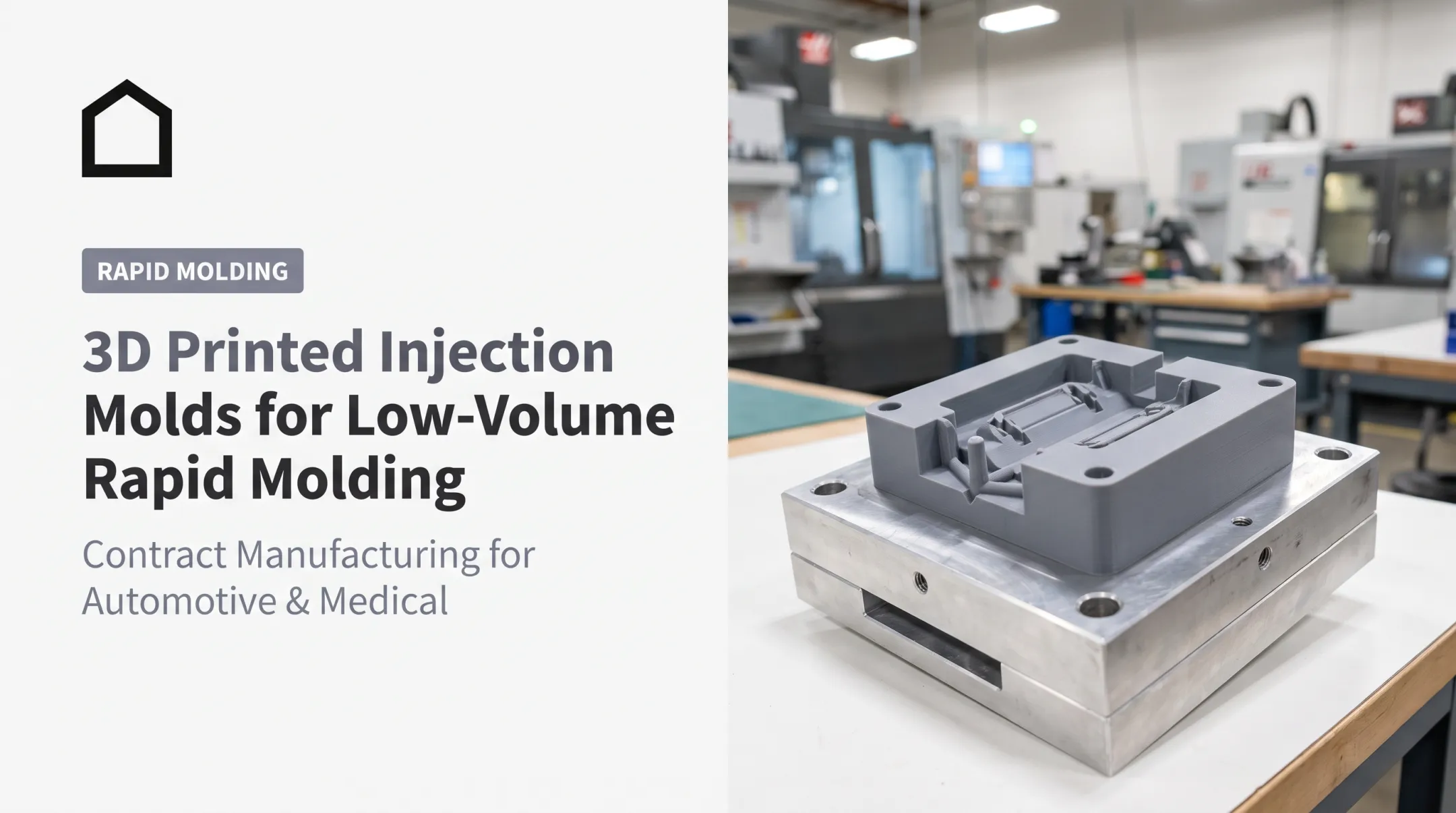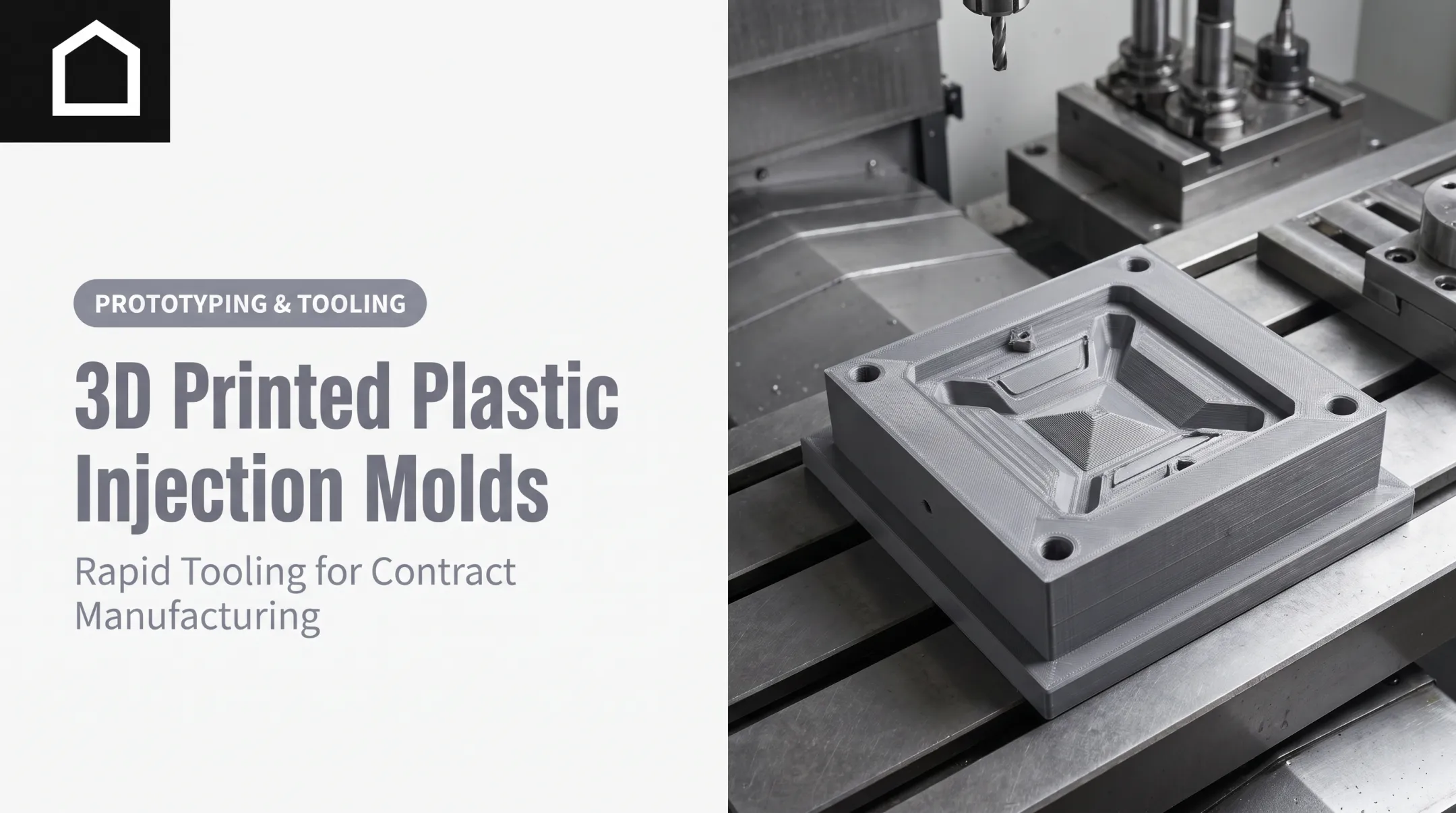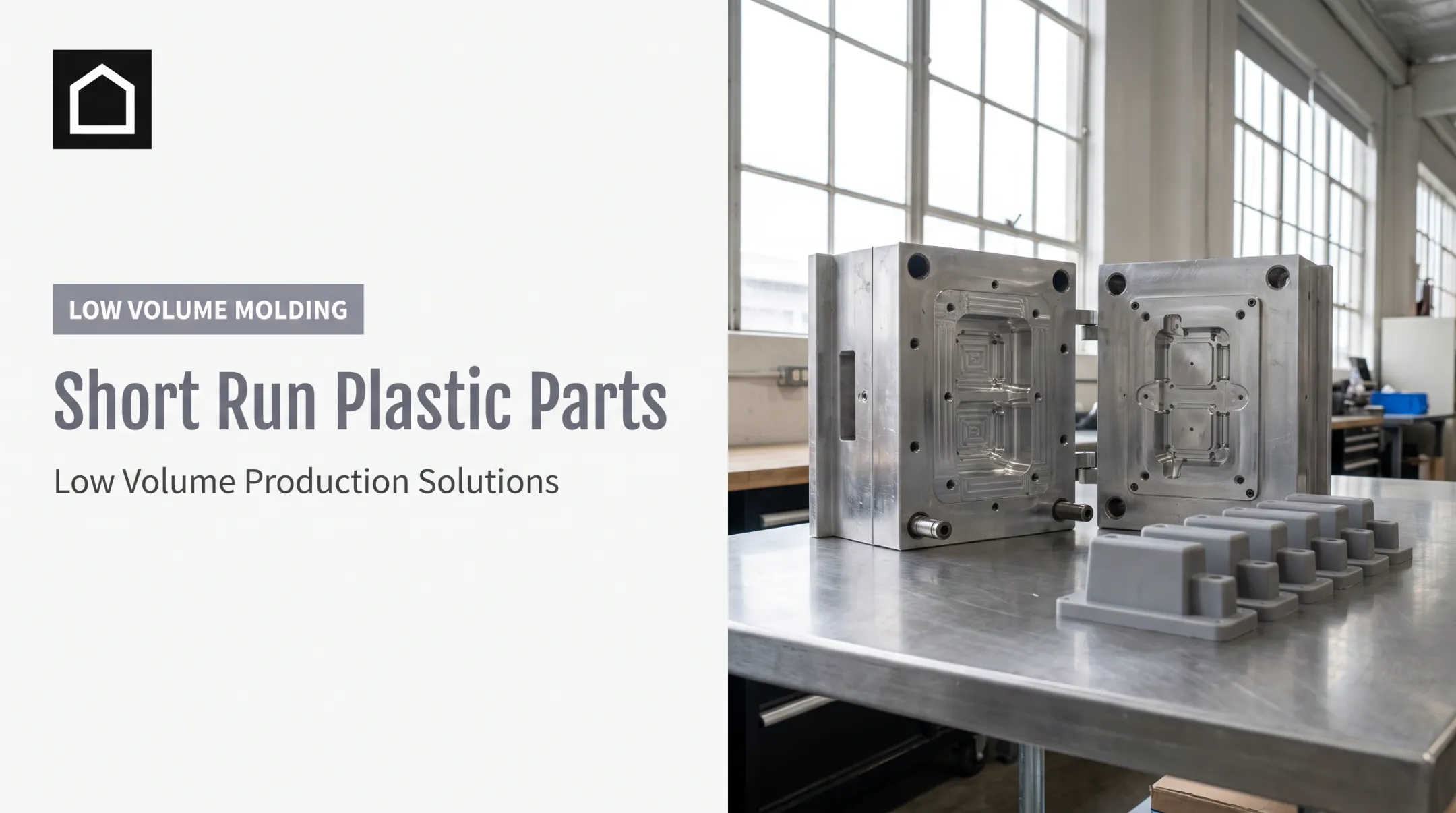

Low volume injection molding solves this. It's the bridge between 3D-printed prototypes and full mass production, typically covering quantities from around 100 up to 10,000 parts, using simplified tooling that costs a fraction of hard steel molds.
This guide walks through how the process works, when to use it, what drives cost, key design rules, and how Finine Design and Manufacturing supports automotive, military, and electronics clients through this exact stage of development.
Key Takeaways
- Low volume molding typically produces 100 to 10,000 units using aluminum or softer steel tooling
- Tooling costs run dramatically lower than the $50,000+ needed for high-volume steel molds
- Supports design validation, market testing, and short-run manufacturing in regulated industries
- Working with one partner for design, tooling, and molding cuts vendor complexity and speeds up launch timelines
What Is Low Volume Plastic Injection Molding?
Low volume injection molding uses the same process as mass production: plastic pellets are melted, then injected into a mold cavity under pressure. The difference is scale and tooling investment.
Fictiv defines low-volume molding as production for finalized designs needing real-world validation, generally in runs of 100 to 10,000 units. Below that, you're in prototyping territory. Above it, you're moving into mid- and high-volume manufacturing with hardened steel tooling built to survive millions of cycles.
What Counts as Low Volume?
Definitions shift depending on who you ask. Seaway Plastics, for example, groups runs roughly as:
- Low volume: 100–10,000 parts
- Mid-volume: 10,000–500,000 parts
- High-volume: 1,000,000+ parts
There's no single universal cutoff, but most molders place low-volume work well under 10,000 units per run.
Low Pressure vs. Low Volume
Low pressure injection molding is a different technique, not a volume tier. It uses reduced clamping force and injection pressure to encapsulate delicate electronics, connectors, and cable assemblies—protecting parts from moisture and vibration without harming sensitive internals.
Finine Design and Manufacturing offers low volume injection molding as one stage in a connected development pathway. Clients move from CAD modeling and 3D printing straight into molded production without switching vendors mid-project.
When to Use Low Volume Injection Molding
Prototyping and Design Validation
Once a design has moved past 3D-printed iterations, engineers often need parts made from the actual production resin and process. That step supports functional testing and first article inspection (FAI).
In automotive work especially, a 3D-printed prototype can't match how injection-molded material behaves under load, heat, or repeated stress. Testing in the real material before hard tooling catches design flaws while they're still cheap to fix.
Bridge and Short-Run Production
Low volume molding also lets companies:
- Launch a product and gauge market demand before scaling up
- Fulfill limited-run orders, like replacement parts or specialty dental and orthopedic products
- Resolve tooling and design issues before investing in expensive steel molds
This approach turns a high-risk, high-capital decision into a staged, lower-risk one. You get production-quality parts without betting the budget on a design that might still need revisions.
Types of Injection Molding and Tooling Options
Injection molding covers several process types. The ones that matter most for product development and short-run production are:
- Standard / high-volume molding — hardened tooling built for sustained, high-shot production
- Low-volume / bridge molding — shorter runs that fill the gap between prototype and full-scale manufacturing
- Prototype / rapid tooling — fast-turn molds used to validate design, fit, and function
- Insert molding — metal or other inserts placed in the cavity before plastic is injected
- Overmolding — a second plastic shot molded over an existing substrate for grip, seal, or multi-material parts
- Micro molding — extremely small, high-precision parts, often under a gram
Micro molding shows up often in regulated work: catheter components, dental brackets, and orthopedic devices such as bone-graft delivery tools, where tight tolerances are non-negotiable.
Aluminum vs. Steel Tooling
Once you know the process type, mold material drives cost, lead time, and how long the tool lasts.
| Factor | Aluminum Molds | Steel Molds |
|---|---|---|
| Upfront cost | Lower | Higher |
| Lead time | Faster (often 1–3 weeks) | Slower (8–12+ weeks) |
| Tool life | Roughly 10,000–100,000 shots | 500,000–1M+ shots |
| Best for | Short runs, bridge production | High-volume, long-term production |

Protolabs notes that short-run aluminum tooling is generally intended for jobs under 10,000 pieces — a strong fit for low-volume and bridge production.
Standalone Molds vs. Master Unit Die (MUD) Inserts
Mold architecture is the other major cost lever.
A standalone mold is a dedicated tool built for one part family. A Master Unit Die (MUD) system uses a reusable frame that stays in the press while interchangeable insert plates swap in and out. That modular setup can cut initial tooling cost and speed changeovers when you are iterating designs or running multiple related parts.

Finine Design and Manufacturing’s in-house tooling and molding capabilities let clients move from a finished design straight to a working mold — without coordinating separate design, tooling, and molding vendors.
Cost Considerations for Low Volume Injection Molding
How much does low-volume injection molding cost? It depends heavily on tooling material, part complexity, and quantity. Xometry reports that tooling for a mid-level order of roughly 1,000-2,000 small parts can run up to $10,000, while more complex geometries or larger orders can climb toward $100,000.
How much does a simple injection mold cost? A basic single-cavity aluminum mold sits at the low end of those ranges. Costs rise with part size, added cavities, or steel construction.
The Cost-Per-Part Tradeoff
Low-volume molds carry a higher per-unit cost than mass production tooling. But the total financial exposure is much lower. You're not sinking six figures into a mold before you know the design is finalized.
Beyond base tooling, several design choices also move the final number:
- Hand loads for inserts that can't be automated
- Sliders and lifters needed for undercuts
- Hot vs. cold runner systems, which affect cycle time and material waste
- Surface finish requirements, since higher-grade SPI finishes take more time and specialized abrasives
Request an itemized quote that separates tooling cost from per-part cost. This makes it far easier to budget as you scale from a first production run toward higher volumes later.

Designing Parts for Low Volume Injection Molding
Minimum Wall Thickness
Wall thickness generally falls between 0.040 and 0.140 inches, though the exact range depends on resin. ABS typically runs 0.045–0.140 inches, while polypropylene can go as thin as 0.025 inches.
Uniform walls matter even more on short runs. Inconsistent thickness causes warping and sink marks as the material cools unevenly—defects that waste a larger share of a limited production lot.
Core Design Fundamentals
Lock these in before tooling:
- Draft angles of at least 0.5–2 degrees so parts eject cleanly from the mold
- Radiused corners instead of sharp internal angles to reduce stress concentration and warping
- Simpler geometry where possible, which keeps soft or aluminum tooling costs down on low-volume programs

Material vs. Tooling Longevity
Material choice affects more than part performance. Commodity plastics like ABS or PP are gentler on tooling, while specialty resins such as PEEK can accelerate mold wear.
For automotive components or devices that face sterilization cycles, weigh performance against tooling life when you request a quote. On low-volume work, that tradeoff often decides whether the tool stays cost-effective for the full run.
Why Choose Finine Design and Manufacturing
Finine operates as a one-stop shop from its San Diego, CA facility. CAD modeling, 3D printing, CNC machining, urethane casting, injection molding, and production painting all run under one roof.
That single-source setup matters most when a project faces regulatory scrutiny and vendor handoffs add risk.
Key advantages include:
- Specialized experience in dental and orthopedic products, plus automotive, military, and consumer electronics
- Fewer vendors on complex or regulated projects, cutting communication gaps and schedule risk
- Turnaround paced to client development timelines, not a rigid production schedule
For teams juggling design revisions, testing requirements, and launch dates, one team for design, tooling, and molding shortens the path from prototype to shippable product.
Frequently Asked Questions
How much does low-volume injection molding cost?
Costs vary based on tooling material, complexity, and quantity, but they're far lower than the $50,000+ typical of high-volume steel tooling. Get a project-specific quote for accurate pricing.
How much does a simple injection mold cost?
A basic single-cavity aluminum mold is the most affordable tooling option, with final pricing shaped by part size, material, and finish requirements.
What is low-volume injection molding?
Low-volume injection molding produces functional, production-grade plastic parts in smaller batches—generally 100 to 10,000 units—using simplified aluminum or pre-hardened steel tooling instead of full hardened steel molds.
What is considered low volume in manufacturing?
Definitions vary by molder and industry, but 100-10,000 parts is the commonly cited range for low-volume production runs.
What is micro molding?
Micro molding produces extremely small, high-precision parts, often under a gram, commonly used in dental brackets, catheter components, and other devices requiring tight tolerances.
What is the minimum thickness for injection molding?
Wall thickness generally ranges from 0.040 to 0.140 inches depending on resin type. Uniform thickness prevents warping and sink marks during cooling.