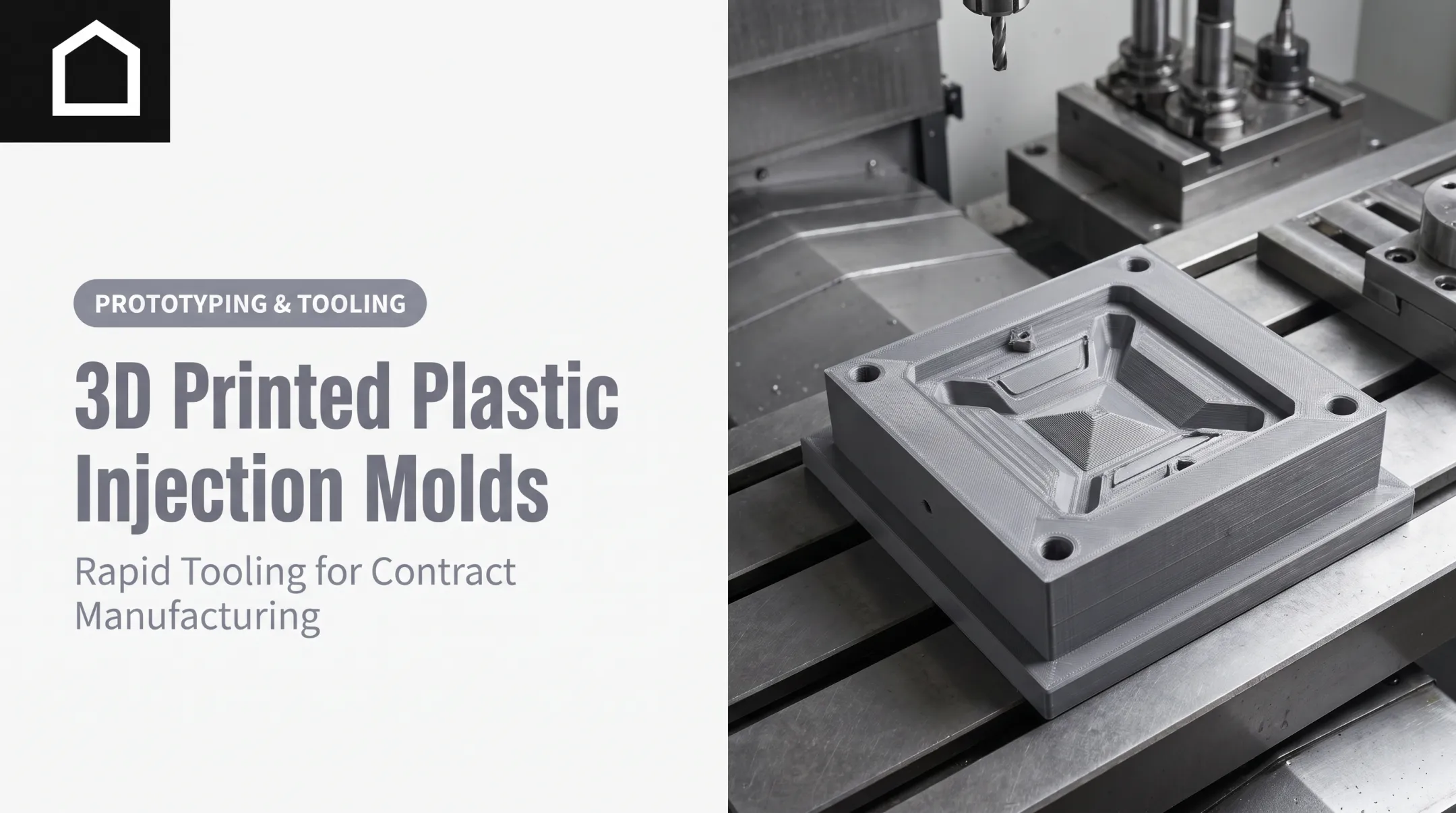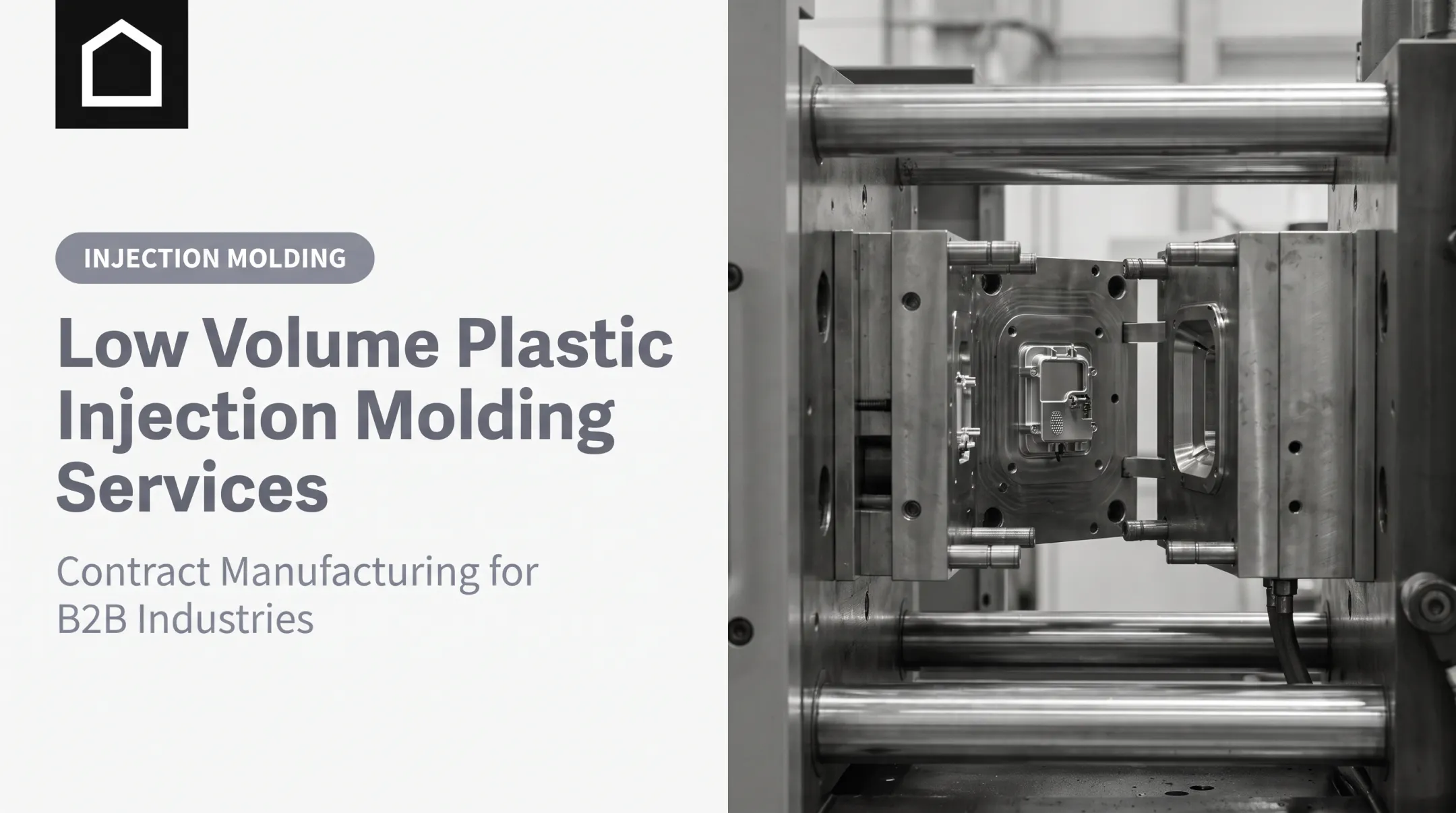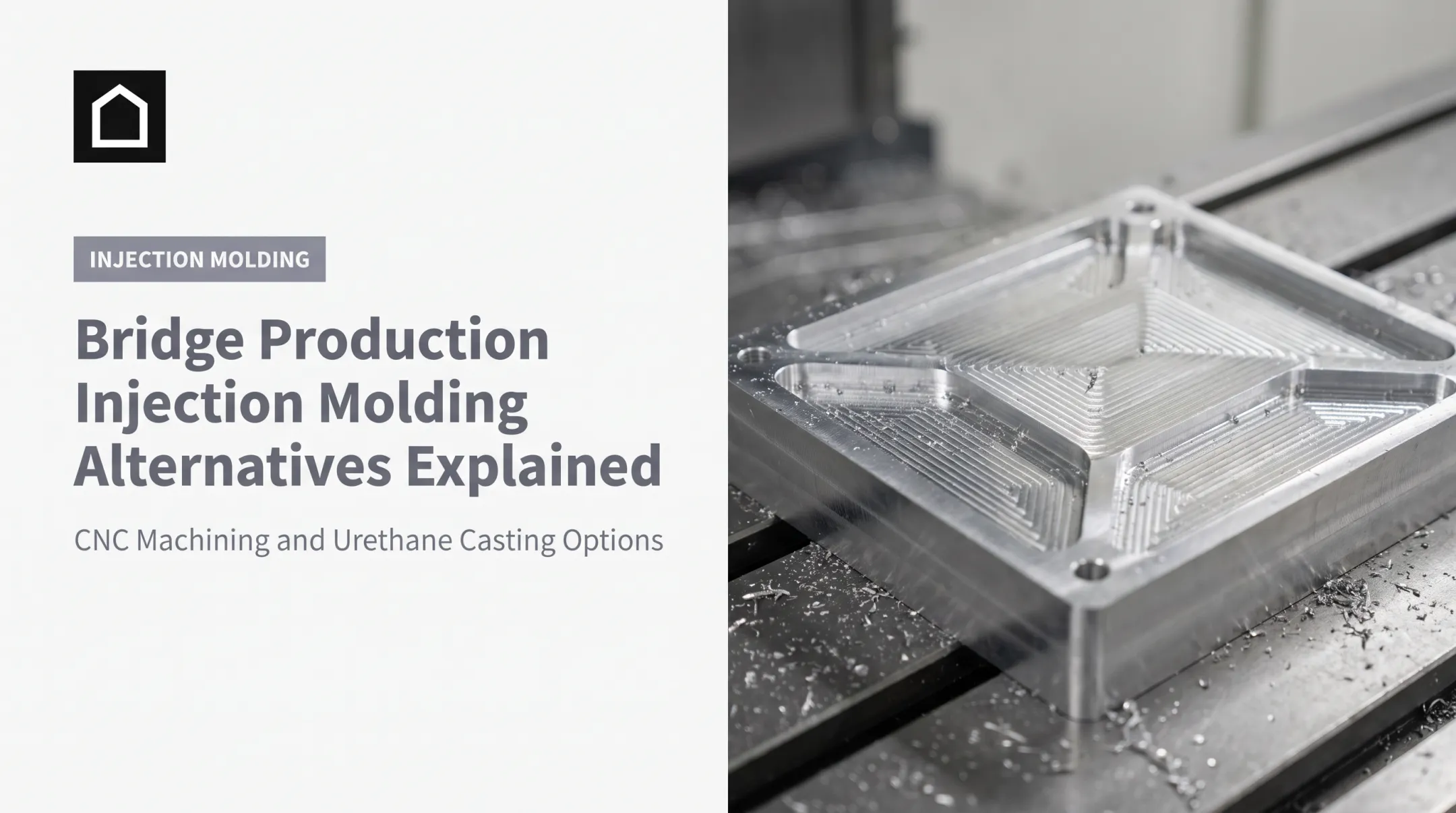

This is where short-run plastic parts come in. Low-volume injection molding, 3D printing, CNC machining, and urethane casting can all produce functional parts without the commitment of hardened production tooling. The right choice depends on your quantity, material requirements, part geometry, and how the parts will ultimately be used.
This guide walks through how to compare these processes, what drives total project cost, where each method tends to fit, and what you need to gather before requesting a manufacturing quote.
Key Takeaways
- Short-run plastic parts cover prototyping, validation, pilot launches, and bridge production; quantity cutoffs vary by process
- Lowest tooling cost ≠ lowest total cost—factor setup, per-part pricing, finishing, and redesign risk
- Injection molding delivers production-grade repeatability; 3D printing, CNC, and urethane casting suit early-stage flexibility
- Match process to geometry, tolerances, surface finish, and demand before committing to tooling
Short-Run Plastic Parts: What They Are and When They Make Sense
Short-run plastic parts are low-quantity components produced for development, validation, limited launches, or bridge manufacturing (the gap between a one-off prototype and full production). There's no industry-wide cutoff for "low volume."
Protolabs describes aluminum-tool injection molding as suitable for 25 to 10,000 or more parts, while Fictiv frames urethane casting around roughly 1 to 100 parts. These are supplier-specific guidelines, not fixed rules: the real answer depends on your part's geometry, material, and order schedule.
Companies typically choose short-run production to:
- Validate a design before committing to hard tooling
- Put a product in front of real users for feedback
- Launch a niche product with limited expected demand
- Fulfill a one-time or limited order
- Keep replacement parts available for discontinued products
- Bridge demand while production tooling is still being built
Prototype parts and functional parts solve different problems. A prototype that looks like your intended product isn't the same as a functional part made from a production-relevant material and process. A 3D-printed housing might nail the fit and appearance, but if your end product needs to handle UV exposure or repeated flexing, you need a part made in the actual candidate resin.
Where Short-Run Production Falls Short
Short-run approaches aren't always the right call. Skip them if:
- The design is still changing weekly, so wait until it stabilizes
- Fewer than 5-10 units are needed (straight prototyping is cheaper)
- Demand is already running into the thousands of units per month
- The application requires specialized validation testing the chosen process can't support
Real-world example: AMETEK Brookfield needed a few hundred RTD-port electronics clips per year — too few to justify dedicated tooling, too many to machine economically one at a time. Formlabs reports the company cut per-part cost from $25 (machined) to $3 (SLS-printed), an 88% reduction, by switching to industrial SLS printing. The lesson: compare annual program cost, not just the price of the first unit.

Low-Volume Production Methods Compared
| Process | Typical run reference | Strengths | Watch out for |
|---|---|---|---|
| Aluminum-tool injection molding | 25–10,000+ parts | Production-grade resin, repeatable | Upfront tooling cost |
| Industrial 3D printing | No fixed cap | Fast iteration, complex geometry | Anisotropy, finish, tolerances |
| CNC machining | 100+ parts | Tight tolerances, real stock material | Material waste, wall thickness limits |
| Urethane casting | ~1–100 parts | Molded look, fine detail | Mold wears after ~25 shots per cavity |
Low-Volume Injection Molding
Aluminum tooling cuts faster and costs less than steel. Protolabs lists aluminum tools starting around $1,500 versus $50,000+ for hardened steel, with aluminum molds good for roughly 10,000+ cycles depending on resin and geometry. That's a meaningful gap for a design that might still see revisions.
Finine Design's CNC aluminum injection mold capability uses this same approach: aluminum tooling machined in-house for prototype, bridge, or low-to-medium volume production, without committing to a hardened steel tool before the design is locked.
3D Printing
No mold required, which means design changes cost nothing but a new file. Industrial processes like SLS or DLP can produce functional parts in production-relevant polymers. The tradeoff: printed parts can be weaker across layer bonds than along them, and surface finish and tolerances vary by machine and material.
CNC Machining
Cutting parts from solid plastic stock gives you real material properties and tight dimensional control. That matters when a part needs to represent the actual candidate resin. Thin walls (around 0.02 inches or less) are prone to breakage, flex, or warp during machining, and deep, narrow features can deflect under the cutting tool.
Material waste and part-size limits—bound by stock and machine capacity—are the main constraints.
Urethane Casting
A master pattern creates a silicone mold, which then casts polyurethane parts that mimic a thermoplastic's look and feel. Fictiv estimates about 25 shots per silicone cavity before the mold degrades.
Finine Design's production urethane casting service specifies resin hardness, color, and fill per project. Cast polyurethane can approximate many thermoplastic properties, but heat and chemical resistance often differ from the intended production resin. Verify before treating cast parts as a stand-in for molded results.
Specialized alternatives worth a mention: thermoforming for sheet-based parts, rotational molding for seamless hollow parts, blow molding for hollow containers, and 3D-printed molds for very small injection-molding trial runs. These fit specific geometries, not general-purpose substitutes.
How to Choose the Right Production Solution
Start with quantity and demand certainty. Compare what you need today against expected follow-on orders and your product's life cycle. A part you'll reorder quarterly for two years justifies different tooling than a one-time batch of 30.
Match Material to Performance Requirements
Common materials and their general molding fit:
- ABS: impact resistance and heat resistance for housings and brackets
- Polypropylene: balances rigidity and impact resistance; widely used in injection molding
- Acetal/Delrin: general-purpose injection grades for precision mechanical parts
- HDPE: injection-molding grades for chemical-resistant applications
- Nylon/PA66: common for load-bearing or wear components
Always pull the current resin grade datasheet. A generic material name doesn't tell you enough: the specific grade determines stiffness, impact behavior, and heat tolerance.
Evaluate Geometry and Manufacturability
Before locking in a process, review:
- Wall thickness and draft angles for clean release and even fill
- Ribs, bosses, and undercuts that drive tooling complexity
- Internal channels and parting-line placement
- Achievable tolerances for the chosen method
Calculate Total Project Cost
Don't compare per-part prices in isolation. Add up:
- Tooling or setup cost
- Programming (for CNC)
- Material and machine time
- Finishing and assembly
- Inspection and documentation
- Shipping and potential redesign costs
Consider a Staged Path
Many programs don't pick one process and stick with it. A common sequence:
- 3D printing for early design iterations
- CNC machining or urethane casting for functional evaluation
- Low-volume injection molding once the design is validated for pilot or end-use parts
Finine Design and Manufacturing follows this same path (Prototype → Bridge Production → Production), with CAD modeling, 3D printing, CNC machining, urethane casting, and injection molding under one roof. Consolidating those stages with one manufacturing partner simplifies coordination as a design matures from early iteration to pilot-ready parts.
From Design File to Finished Parts
Getting from a design file to finished short-run parts follows a repeatable sequence. Skipping a step usually shows up later as scrap, delays, or a tool re-cut.

- Define requirements and target quantity
- Review or create CAD
- Select material and process
- Complete design-for-manufacturing feedback
- Produce a prototype or soft tool
- Manufacture the short run
- Inspect to the agreed plan
- Finish or assemble
RFQ Checklist
Send your manufacturing partner:
- 3D CAD files and a 2D drawing
- Target quantity (and expected reorders)
- Material or approved alternatives
- Critical dimensions and tolerances
- Finish and color requirements
- Inserts or secondary operations needed
- Testing requirements
- Packaging and delivery target
Why Early Design Review Matters
A design review before cutting a tool or programming a CNC path can catch thin walls, insufficient draft, trapped features, and tolerances that drive up cost. Fixing these on screen costs nothing. Fixing them after a mold is cut costs real money and real time.
Quality Planning for Low-Volume Runs
First-article inspection is not the same as lot sampling. SAE's AS9102C standard governs documented first-article inspection; ISO 2859-1 covers attribute-based acceptance sampling for full lots. Know which one your project actually needs — a single verified first article doesn't replace a sampling plan for a 500-unit order, and vice versa.
When moving toward full production tooling later, document the material, process choices, and design intent now. That record tells you which features might need adjustment when the part transitions to hardened steel tooling.
Common Applications for Short-Run Plastic Parts
Short-run plastic parts show up wherever volume is low and the design may still move:
- Automotive: Prototype assemblies, replacement components, and limited-production interior or exterior parts for fit and material checks before full tooling
- Military and defense: Prototype hardware, specialized components, and maintenance parts
- Consumer electronics: Housings, brackets, buttons, and internal components for fit checks and pilot launches
- Medical, dental, and orthopedic: Development work and specialized lower-volume products
According to a Stratasys case study on C-17 aircraft sustainment, U.S. Air Force lavatory drip-pan replacements fell from roughly $10,000 to $1,200 with industrial 3D printing. Material, documentation, and procurement requirements still need confirmation for each program.

For medical and dental work, the manufacturing method alone does not establish regulatory compliance. Verify biocompatibility, sterilization, and validation against FDA guidance and standards such as ISO 13485 and ISO 10993-1.
Quick Decision Guide
| Need | Process to investigate first |
|---|---|
| Early prototype | 3D printing |
| Functional test part | CNC machining |
| Limited end-use parts | Urethane casting or aluminum-tool molding |
| Complex custom geometry | 3D printing |
Finine Design and Manufacturing works across all four categories above: automotive, military, consumer electronics, and medical/dental. The team has particular depth in dental and orthopedic product development, where prototype-to-bridge-production transitions come up often.
Conclusion
Short-run plastic parts sit between one-off prototyping and full-scale manufacturing. But no single process wins for every quantity, geometry, material, or performance need — the right answer depends on your specific part.
Before you contact a manufacturing partner, pull together:
- CAD files
- Quantity forecast
- Material preferences
- Tolerance requirements
- Finish expectations
- Testing needs
Finine Design and Manufacturing can review which process fits your project. Reach out at Jaime@fi9design.com or 1.858.900-9787.
Frequently Asked Questions
Can common plastics like Delrin (acetal), polypropylene, and HDPE be injection molded?
Yes. Suitable grades of all three are regularly injection molded. DuPont publishes Delrin grades designed for injection applications, and similar grades exist for PP and HDPE. Always verify the resin datasheet matches your application.
What is the most commonly used manufacturing method for plastics?
Injection molding is the primary method for repeatable, higher-volume plastic production. For short runs or complex geometries, 3D printing, CNC machining, urethane casting, thermoforming, or extrusion often fit better.
What is the cheapest plastic?
Commodity resins such as polypropylene and polyethylene usually have the lowest raw-material cost. In short-run work, tooling and process choice often drive total part cost more than resin price alone.
What is low-volume manufacturing and what is considered low volume?
Low-volume manufacturing means producing a limited quantity for prototypes, pilot runs, niche products, or bridge production. The cutoff depends on the process: it might be about 25 parts for molding or 100 for casting.
How can I tell if a plastic part is injection molded?
Look for parting-line seams, gate marks, ejector-pin marks, and consistent wall sections with ribs or bosses. These are useful clues, but visual inspection alone doesn't always confirm the process.
What are the main components of plastic?
Most production plastics start with a base polymer resin, then add fillers, colorants, stabilizers, or reinforcements to hit strength, heat, or appearance targets for the part.