
Introduction
Need a part that flexes, grips, or absorbs an impact before committing to a production mold? Many product teams hit this exact wall: a prototype needs to feel like rubber, not hard plastic, but doesn't yet justify the cost and lead time of injection tooling.
Flexible urethane casting resin solves that problem. It's a two-part polyurethane system that pours into a silicone mold and cures into an elastomeric part, ranging from slightly pliable to fully rubber-like depending on the formulation.
One manufacturer's product line alone spans Shore 25A to 85A, with tensile strength, elongation, and tear resistance shifting by grade (Polytek, 2021 technical bulletin). That range is the whole point—and the challenge: "flexible" alone doesn't tell you enough.
This guide covers what the material actually is, how it compares to rigid urethane, silicone, and epoxy, which properties matter for your part, how the casting process works, and what drives cost.
Key Takeaways
- Flexible urethane is a two-part polyurethane; hardness and durability track formulation and cure conditions.
- Match resin to movement, load, and environment—not the word "flexible" on the label.
- Best for detailed prototypes, bridge production, and short runs before injection tooling.
- Automotive, defense, dental, and orthopedic uses need independent testing before production.
What Are Flexible Urethane Casting Resins?
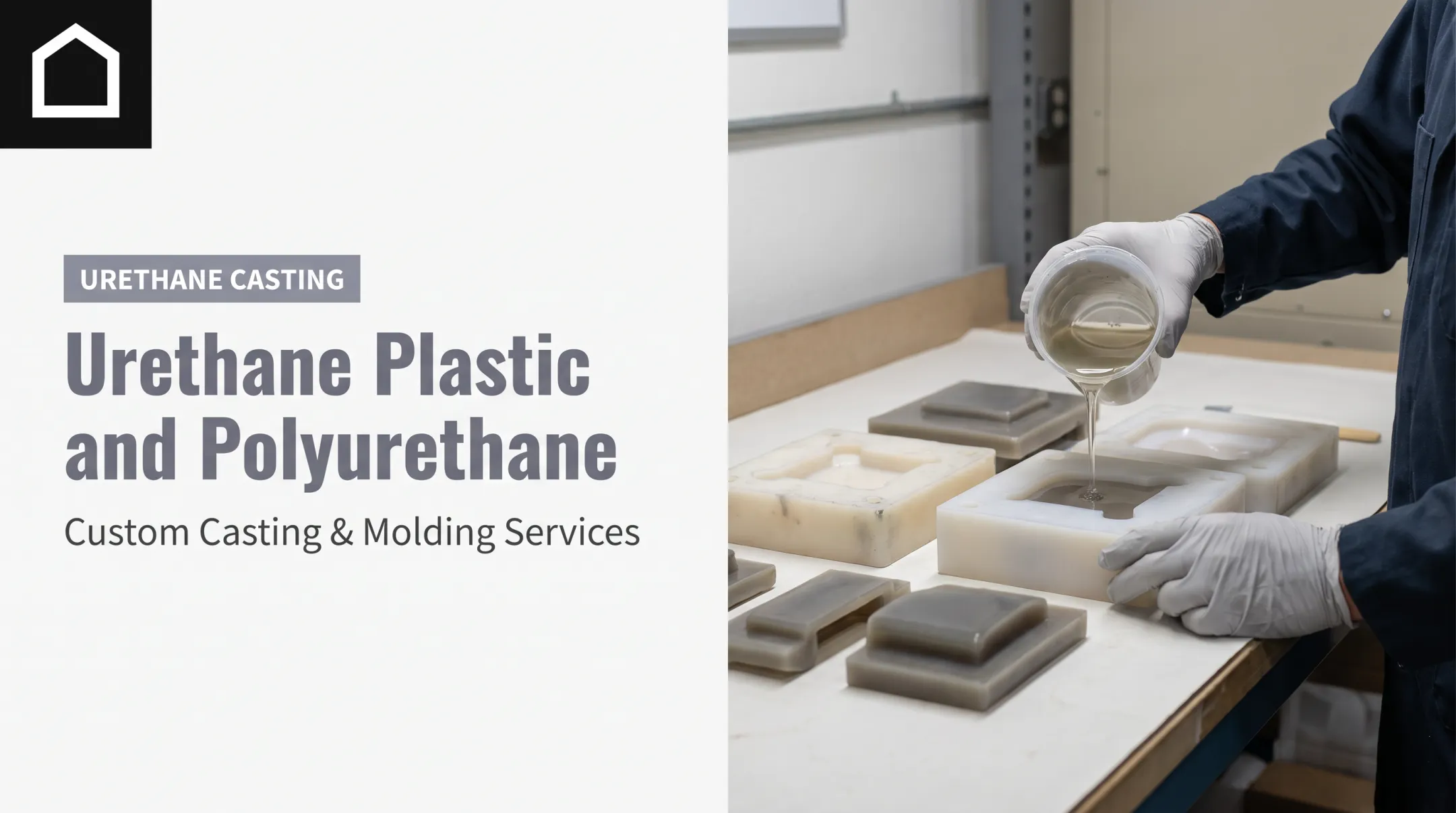
A flexible urethane casting resin is a liquid, two-component polyurethane system. You mix it, pour it into a silicone mold, and it cures into an elastomeric part with a hardness you've specified ahead of time.
Flexibility runs on a spectrum, from a softer-touch skin to a fully rubber-like component. It is not the same as elongation, tear resistance, abrasion resistance, or rebound after repeated squeezing. A soft part can still tear easily. A firmer one can still flex plenty.
How Cured Properties Vary by Grade
Published manufacturer data shows how widely "flexible" grades can differ:
| Resin | Hardness | Tensile Strength | Elongation | Tear Strength |
|---|---|---|---|---|
| Polytek PT Flex 20 | Shore 25A | 177 psi | 501% | 46.7 pli |
| Polytek PT Flex 50 | Shore 50A | 284 psi | 242% | 57.2 pli |
| Polytek PT Flex 85 | Shore 85A | 842 psi | 183% | 194.2 pli |
| BJB F-164 FR | Shore 60±5A | 720 psi | 290% | 85 pli |

These numbers are specific to these formulations, not universal benchmarks for every flexible urethane on the market (Polytek, 2021 technical bulletin).
Flexible Urethane vs. Rigid Urethane, Silicone, and Epoxy
- Rigid polyurethane casting resin: Best for structural or hard-shell parts that should not bend or compress.
- Silicone rubber: Often more flexible and heat-tolerant, but usually differs in strength, detail reproduction, paintability, and unit economics.
- Epoxy resin: A different chemistry, typically chosen for rigid, hard, or heavily bonded parts—not elastomeric ones.
What to Check on the Data Sheet
Before picking a resin, review:
- Shore hardness and tensile strength
- Elongation and tear strength
- Abrasion resistance and rebound/resilience
- Compression set and density
- Cure time and service-temperature range
The same resin can behave differently depending on mold design, mix ratio, degassing, cure conditions, pigment load, wall thickness, and post-processing. A grade that works for a prototype is not automatically cleared for final-use medical, automotive, defense, or food-contact parts. Those uses need application-specific testing and documentation.
Why Use Flexible Urethane Casting Resins and Where Are They Used?
Jumping straight to hard production tooling is expensive and slow. Flexible urethane casting bridges that gap:
- Lower initial tooling investment than hard injection tooling
- Realistic tactile feel and fine detail reproduction
- Customizable hardness, color, and fill per project
- Practical for limited quantities where a production mold isn't justified yet
Where Controlled Flexibility Adds Value
Common applications include:
- Grips, seals, gaskets, and soft-touch housings
- Bumpers, wheels, and protective covers
- Ergonomic interfaces and impact-absorbing parts
- Demonstration and fit-check models
Automotive, consumer electronics, dental, orthopedic, and defense teams cast these parts for prototypes and specialized low-volume runs. Each program still needs material validation for its own use case.
How It Compares to Other Processes
| Process | Tooling Investment | Realism/Flexibility | Typical Use |
|---|---|---|---|
| Urethane casting | Low to moderate (silicone mold) | High, production-representative | Prototypes, bridge production, short runs |
| 3D printing | Minimal to none | Lower for true elastomeric feel | Single parts, masters, fast iteration |
| CNC machining | Low (per part) | Depends on material | Rigid prototypes, masters, tight tolerances |
| Injection molding | High (hard tool) | High, exact production material | High-volume production |
A silicone mold can produce roughly 50 casts before it needs replacing—a useful planning number, not a guarantee (Formlabs, 2023). Plan around a few practical limits:
- Visible parting lines or occasional bubbles on cast parts
- Dimensional behavior that may differ slightly from the eventual production material
- High-volume programs that are usually better served by injection molding
Choose flexible urethane casting when you need realistic elastomeric behavior—or a small-to-moderate batch of detailed parts—before you invest in production tooling.
How to Choose the Right Flexible Urethane Casting Resin
Define the Functional Requirements First
Start with what the part actually has to do, not the resin brand on the bottle.
- Does it bend, compress, stretch, absorb impact, damp vibration, grip, or seal an opening?
- Or does it just need to simulate the feel of a future production part?
- Will it see repeated flexing, abrasion, compression, tensile loading, chemicals, moisture, sunlight, or heat?
Use Hardness as a Starting Point, Not the Final Answer
Shore hardness signals firmness, but it does not predict tear strength, elasticity, or long-term performance on its own. Parts in a similar hardness range can still behave very differently under load:
- Soft-touch overmolded grips
- Firmer wheels or bumpers
- Structural flexible brackets
Validate for the Real Environment and Finish
Check each candidate resin against the environment it will actually see:
- Temperature limits
- Chemical and moisture resistance
- UV exposure and hydrolysis risk
- Abrasion resistance and compression set
For medical, dental, orthopedic, military, or automotive programs, map the real testing, traceability, biocompatibility, and flammability requirements early. FDA guidance on biological evaluation under ISO 10993-1 applies to the finished, processed device—not a prototype resin's data sheet (FDA, 2023).
Appearance matters too:
- Color matching, translucency, and surface texture
- Paint adhesion, gloss, and pigmentation
- Master-pattern quality and mold surface condition, both of which shape the final cosmetic result
Account for Quantity and Total Cost
Total cost is more than resin price. A quote usually rolls up:
- Master creation and mold fabrication
- Resin volume, pigment, and inserts
- Labor, finishing, inspection, and packaging
- How many parts the mold will yield before it wears out
Ask for both per-part pricing and tooling or setup costs so you can fairly compare urethane casting against 3D printing, CNC machining, and injection molding.
Before committing, ask your casting provider for:
- A material data sheet for the specific resin grade
- A sample part to evaluate feel and finish
- Estimated dimensional tolerances and mold life
- Finishing options and whether the resin represents the intended production material
How Does Flexible Urethane Casting Work?
From CAD Review to Finished Part
- Review the CAD model for wall thickness, draft, undercuts, split lines, inserts, and areas that could trap air.
- Build a master pattern, usually with CNC machining or 3D printing, then finish it to the required surface standard.
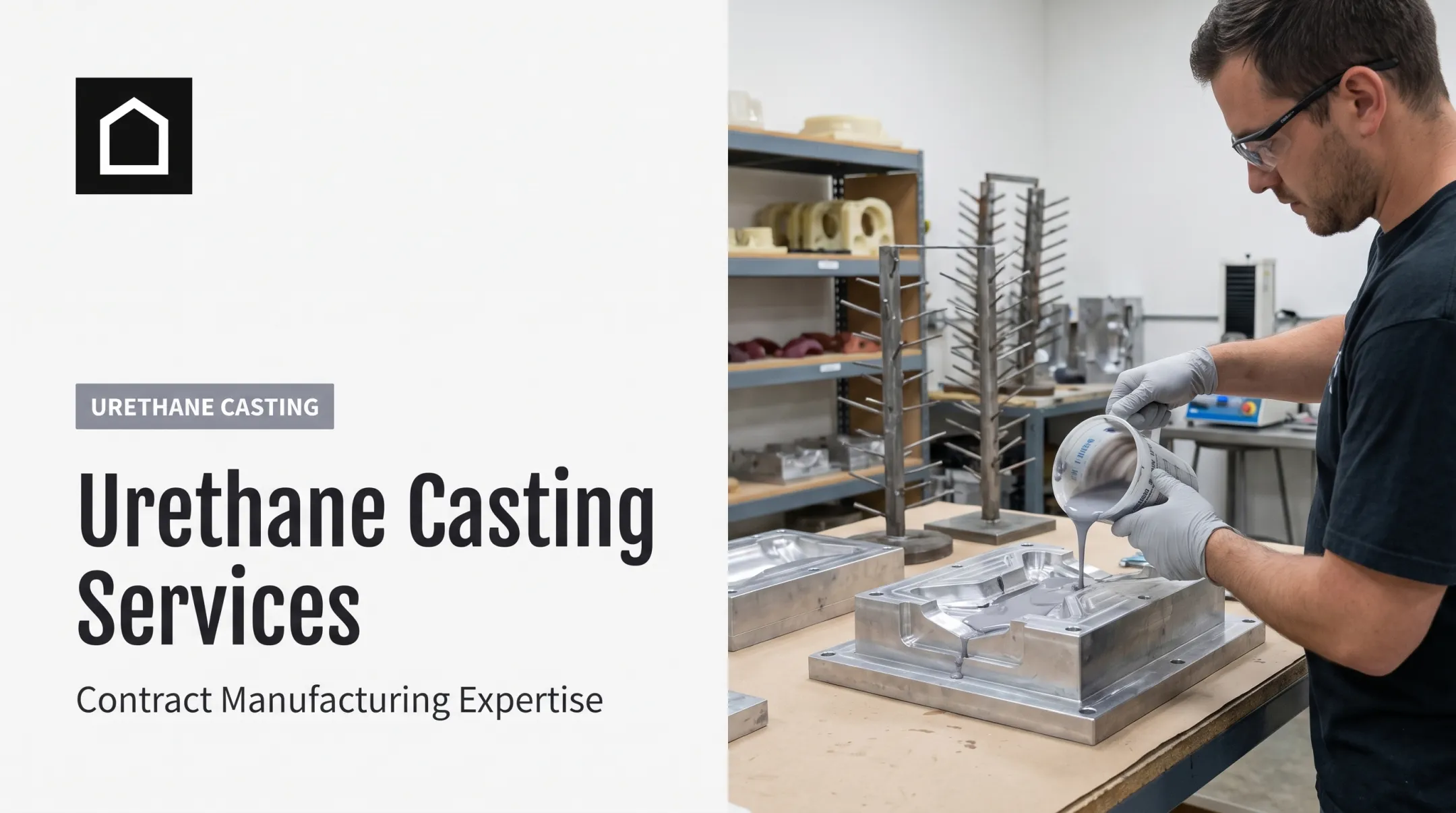
- Build a silicone mold around the master, establishing a parting strategy plus gates, vents, and registration features.
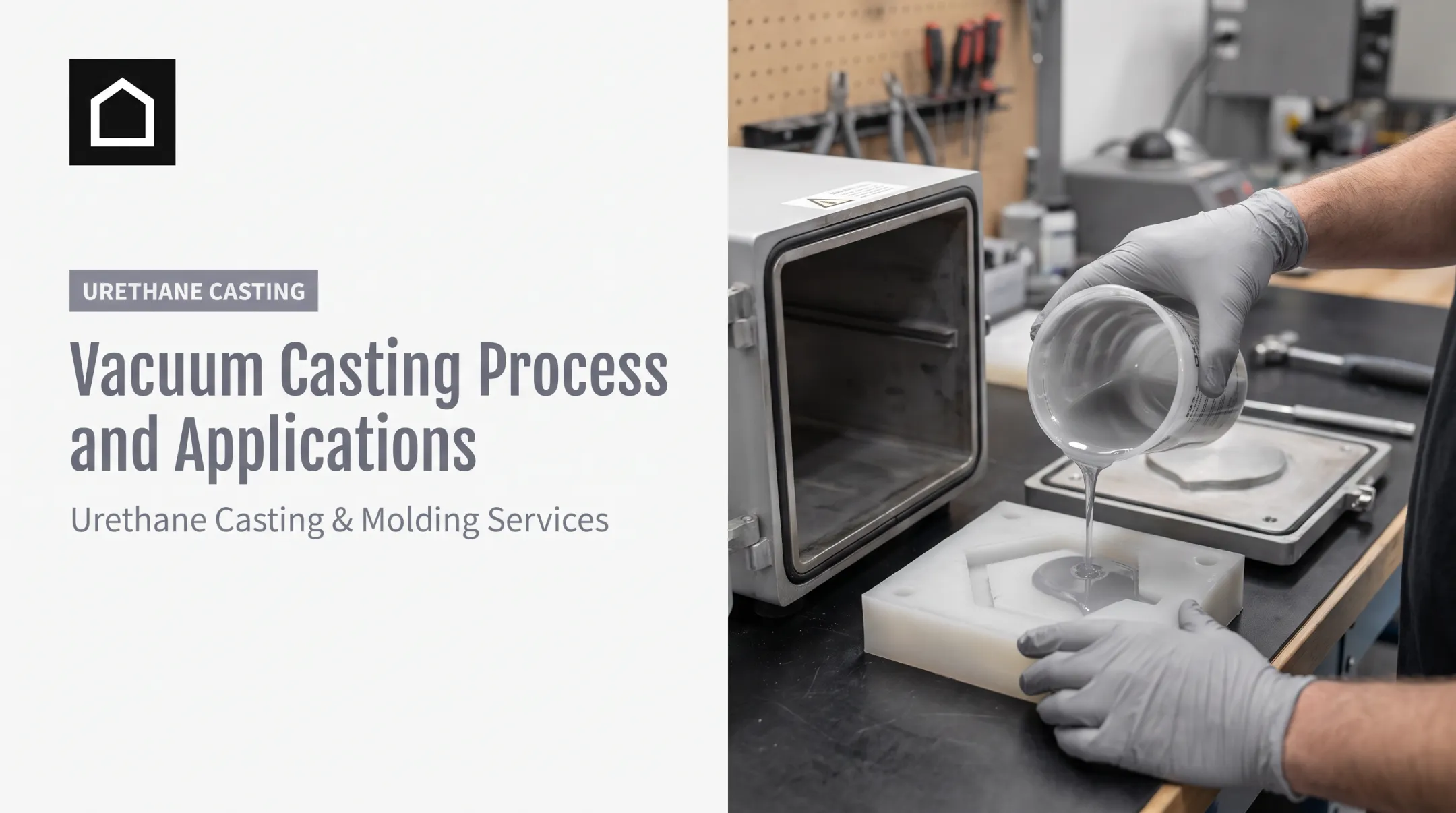
- Mix and degas the resin, add color or fillers, pour or inject, and cure under controlled conditions.
- Demold, trim flash, inspect, then paint, bond, or assemble as needed.

Design Details That Affect Quality
Minimum wall thickness and draft guidance vary by resin and mold process. Set them for the specific project rather than a generic rule.
Features that raise the risk of tearing, distortion, or incomplete fills:
- Thin sections and sharp internal corners
- Deep undercuts and long flow paths
- Inconsistent wall thickness
Design choices that help prevent those problems:
- Generous radii and controlled transitions
- Accessible parting lines
- Planned gate locations
Inspection, Testing, and Common Defects
Depending on the part, inspection may include:
- Dimensional checks and visual review
- Hardness, tear, or tensile testing
- Compression or flex-cycle testing
- Environmental exposure and fit testing
Testing a prototype for feel and fit is a different bar than qualifying a part for repeated service or regulated use.
Common defects and their usual causes:
- Bubbles or voids from trapped air during mixing or pouring
- Incomplete fills from flow or temperature issues
- Flash from mold mismatch
- Tackiness from incorrect mixing or cure
- Distortion from demolding too early
Always follow the resin manufacturer's processing instructions for corrective action.
Finine Design and Manufacturing combines CAD modeling, 3D printing, CNC machining, urethane casting, injection molding, and production painting under one roof in San Diego. That matters when a project needs support moving from a single prototype through bridge production and into a longer-term manufacturing decision.
Conclusion
Flexible urethane casting resins earn their place when a project needs detailed, realistic, elastomeric parts for prototypes, bridge production, or specialized low-volume runs. Match the resin to the part's function: flexibility, hardness, strength, environment, finish, quantity, and testing needs, plus fit with your eventual manufacturing path.
Bring those requirements to a qualified casting partner before locking in a resin. Finine Design and Manufacturing works with automotive, military, consumer electronics, dental, and orthopedic clients on exactly this kind of decision. Reach out to Jaime at Jaime@fi9design.com or 1.858.900-9787 to talk through a project.
Frequently Asked Questions
What is urethane casting resin?
Urethane casting resin is a liquid, two-component polyurethane system that cures inside a mold, usually silicone, to form a finished part. Flexible formulations produce rubber-like parts whose hardness and performance vary by grade.
Is there a difference between epoxy resin and casting resin?
"Casting resin" describes a process, not a chemistry, while epoxy names a specific resin family usually used for rigid parts. Flexible polyurethane casting resins are a different chemistry built for elastomeric, rubber-like components.
How much does polyurethane resin cost?
Cost depends on formulation, quantity, part size, color, mold fabrication, finishing, labor, and testing requirements. Request a project-specific quote rather than relying on a general price figure.
What is flexible urethane casting used for?
Common uses include flexible prototypes, grips, seals, bumpers, protective covers, soft-touch components, and impact-absorbing parts. Automotive, medical, military, and consumer electronics teams also rely on it for short-run and specialized components.
How do you choose the right hardness for flexible urethane casting resin?
Hardness should be selected alongside elongation, tear strength, compression set, abrasion resistance, and the environment the part will face. The part's intended movement or load matters more than the Shore number alone.