
This guide is written for product designers, engineers, OEMs, and manufacturing teams working in automotive, defense, consumer electronics, dental, and orthopedic product development. If you need production-like parts without the upfront cost of hard tooling, this process deserves a closer look.
Urethane casting gets mentioned constantly as a "prototyping solution," but the operational details — mold life, resin selection, vacuum mechanics, cost drivers — rarely get explained clearly. We'll cover the process step by step, the material and design factors that affect outcomes, where it fits in a product lifecycle, and when another manufacturing route makes more sense.
Key Takeaways
- Vacuum urethane casting pairs a silicone mold with vacuum-assisted resin processing to produce detailed, repeatable parts in limited quantities.
- It works best for functional prototypes, bridge production, and custom runs where injection tooling isn't yet justified.
- Part quality hinges on the master pattern, resin choice, vent and gate design, and cure control.
- Compared to injection molding, CNC machining, and industrial 3D printing, casting trades long-term durability for lower upfront investment.
- It's not automatically the right choice for high-volume runs, extreme environments, or complex internal geometry.
What Is Low-Volume Vacuum Urethane Casting and Why Is It Used?
What Is Low-Volume Vacuum Urethane Casting?
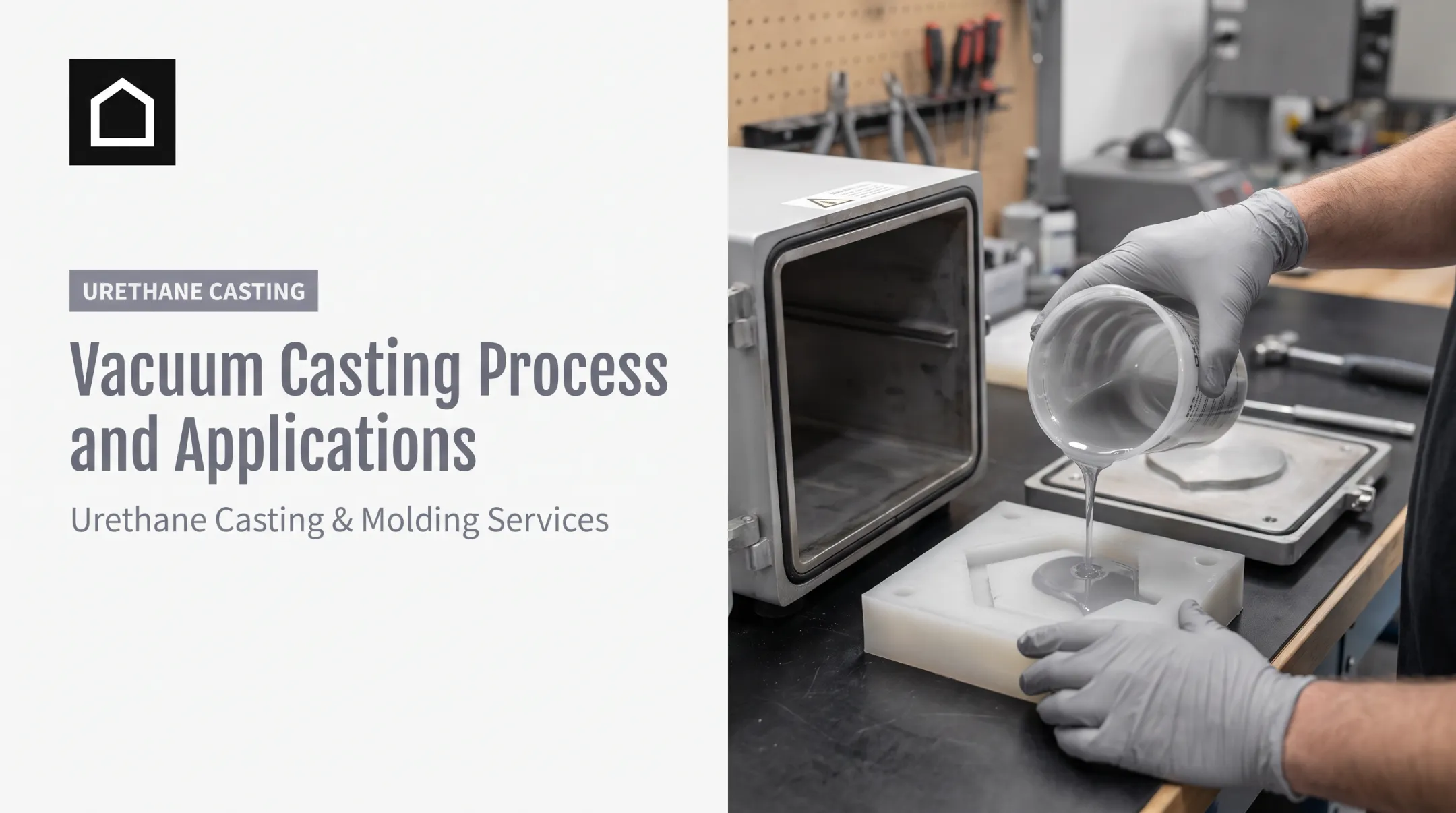
Vacuum urethane casting involves pouring or injecting liquid polyurethane resin into a silicone mold while applying vacuum, either to the mixed resin, the mold cavity, or both. The vacuum pulls out trapped air before and during fill, which reduces bubbles and helps the resin reach fine detail and thin walls.
Four elements determine the outcome:
- CAD model and master pattern: establishes the geometry every cast part will share
- Silicone mold: captures surface detail, texture, and undercuts from the master
- Polyurethane resin: determines hardness, flexibility, color, and performance
- Vacuum system: supports more complete filling and reduces trapped air
Similar-sounding terms are not the same process. Conventional cast urethane molding can skip vacuum degassing entirely; Smooth-On notes that some of its low-viscosity resins don't require it.
Low-pressure urethane casting delivers resin at limited pressure rather than under vacuum. It differs from both vacuum casting and high-pressure injection molding, where molten thermoplastic is forced into a metal tool. When you request a quote, name the actual process. These terms are not interchangeable.
Why Is It Used for Low-Volume Production?
Silicone tooling costs less and takes less time to produce than steel or aluminum injection molds. Formlabs' 2023 guide cites an illustrative silicone-mold cost of $200 to $1,000, with a master-to-finished-part turnaround around 10 days in its example — figures that vary by supplier and part, not universal pricing.

Typical use cases include:
- Functional prototypes for testing before tooling commitment
- Market or user evaluation parts
- Pre-production validation runs
- Bridge production while injection tooling is being built
- Replacement or service components
- Customized, low-repeat-order products
Polyurethane systems can be formulated to approximate the look and feel of production plastics or elastomers — but always verify hardness, impact resistance, and chemical behavior against the actual supplier technical data sheet, not a general material category.
A practical decision rule: choose casting when the design is reasonably mature, the run is limited, and production-like appearance or material behavior matters more than unlimited volume. For safety-critical or regulated parts, involve engineering review before committing to any single process.
How the Vacuum Urethane Casting Process Works (Conceptual Flow)
The process runs from design review through master-pattern creation, silicone mold fabrication, resin preparation, vacuum casting, curing, demolding, inspection, and finishing. Each stage affects the next, so errors early in the chain tend to show up in every part of the batch.

Step 1: Prepare and Review the Master Pattern
Start with a production-intent CAD model or a physical pattern. Review draft angles, parting lines, undercuts, wall thickness, sharp corners, surface finish, and shrinkage allowance before anything gets molded.
The master pattern is typically produced via CNC machining, 3D printing, or another high-resolution method. Any surface defect or dimensional error in the master transfers directly to every cast part. The mold has no capacity to correct it.
Step 2: Build the Silicone Mold
The master pattern gets positioned, gated, and vented before liquid silicone is poured around it. Once cured, the mold is split or opened for pattern removal.
Mold flexibility is an advantage: it accommodates some undercuts and inserts that would be impossible with rigid tooling. Flexibility still has limits:
- Parting lines can tear under repeated flexing
- Flash forms at poorly sealed seams
- Mold support fixtures matter for dimensional stability
- Repeated demolding wears the cavity surface
Published mold-life examples vary widely: Xometry Pro's design guide cites 10 to 20 casts per mold, while other vendor estimates run closer to 50. The range depends on resin chemistry, part geometry, and demolding technique. Ask your supplier for a part-specific expectation rather than assuming a universal number.
Step 3: Prepare the Polyurethane Resin
Resin selection depends on the properties your part needs:
- Hardness and flexibility
- Strength and impact resistance
- Heat and chemical exposure
- Color, transparency, and flame behavior
No single resin covers every application.
Accurate component ratios, controlled mixing, appropriate working time, and moisture control all matter here. Humidity and ambient temperature can affect cure quality, so generic cure-time figures shouldn't be treated as universal across resins or shop conditions.
Step 4: Apply Vacuum Assistance and Cast the Part
Vacuum removes air from the mixed resin, the mold cavity, or both, which reduces bubbles, voids, and incomplete fills. Controlled filling decides whether material reaches thin sections and fine detail before cure begins. That means managing flow rate, mold orientation, gate and vent placement, vacuum level, and the resin's pot life together.
Step 5: Cure, Demold, Inspect, and Finish
The part stays in the mold until sufficiently cured. Once opened, the casting is removed, trimmed, inspected, and finished.
Inspection should check for:
- Flash and air entrapment
- Short fills and warpage
- Dimensional conformity against the drawing
- Surface quality and color consistency
- Functional fit with mating parts
Documented acceptance criteria matter especially for production orders, not just one-off prototypes.
This full workflow (CAD, master creation, silicone tooling, casting, and finishing) is the kind of multi-step project Finine Design and Manufacturing handles under one roof in its San Diego facility. Connecting 3D printing or CNC master creation with urethane casting and production painting keeps parts from bouncing between vendors as a design matures.
Where Vacuum Urethane Casting Is Applied and What Affects Results
Where Is the Process Applied?
Vacuum urethane casting shows up across several industries and lifecycle stages:
- Automotive — prototypes, interior and exterior components, low-volume development parts
- Defense and military — development prototypes and specialty production runs
- Consumer electronics — housings, enclosures, cosmetic and functional prototypes
- Dental and orthopedic — custom components and educational models
- General product development — appearance models, user testing parts, bridge production
One documented example: Paragon's 2023 case study describes Twisted, a customization shop, using vacuum casting for low-volume engine covers with a heat-resistant resin chosen for the application. Named customer cases like this beat generic capability claims when you evaluate a vendor.
Expected quantity and repeat-order frequency drive tooling decisions. A one-time prototype run has different mold-life math than a recurring short-run production schedule.
Material and Part-Design Factors
Resin properties that influence results include hardness, flexibility, strength, impact resistance, thermal limits, chemical resistance, color, and transparency. Always check these against the actual technical data sheet for the grade being used, not a general product category.
Design choices also matter:
- Uniform wall thickness improves fill consistency and reduces warpage
- Suitable draft angles ease demolding and extend mold life
- Radiused corners reduce stress concentration and tearing risk
- Accessible parting lines simplify mold opening
- Adequate gates and vents prevent trapped air and short fills
Shrinkage varies by resin, geometry, mold design, and cure conditions. Materialise's process guidance lists a standard tolerance of ±0.3%, with a ±0.3 mm minimum for parts under 100 mm. Treat that as a reference point; critical dimensions still need supplier validation against the specific part.

Equipment, Scale, and Quality Controls
Throughput depends on vacuum equipment, mixing and metering practices, mold condition, environmental control, and the number of molds running in parallel. There's no universal production rate here. Ask for examples specific to your part size and batch quantity rather than assuming a standard cycle time applies.
For automotive, defense, dental, and orthopedic applications, quality and compliance considerations often include traceability, material documentation, and inspection records. Casting the part doesn't establish compliance by itself. Regulatory requirements depend on the end application and should be agreed on with the manufacturer before production starts.
Common Issues and When It May Not Be Appropriate
Common Issues and Misconceptions
A common assumption is that vacuum processing eliminates every defect. Poor mold design, moisture contamination, incorrect mixing ratios, inadequate venting, or rushed demolding can still cause voids, flash, distortion, and surface defects. Vacuum reduces one failure mode, not all of them.
Another misconception is that a silicone mold corrects the master pattern. It reproduces the pattern exactly. Rough surfaces, inaccurate CAD translation, poorly placed parting lines, and unaddressed shrinkage will repeat across the entire batch.
And "low-volume" doesn't mean unlimited volume at flat economics. As quantities climb:
- Mold wear accelerates, requiring replacement tooling
- Finishing labor adds up across more parts
- Inspection requirements can scale with order size
- Repeat orders change the per-part cost math
When Another Process May Be Better
Several signals suggest casting isn't the right fit:
- Volume forecasts exceed mold life economics: if projected quantity consistently outpaces replacement-tool costs, injection molding likely wins
- Geometry includes internal channels or moving assemblies: standard vacuum casting typically excludes these features
- Extreme long-term environmental exposure is required: specialized certified materials may need a different process entirely
- Tolerances are tighter than resin shrinkage allows: CNC machining offers more predictable dimensional control
- The design is still unstable: casting locks in a geometry; if that geometry is still changing weekly, you're paying for tooling you'll discard
Before picking a manufacturing route, review these factors together:
- CAD files and design maturity
- Target quantity
- Required material properties and operating environment
- Tolerances and appearance expectations
- Testing plan and delivery requirements
A process selected by default (because it's familiar, not because it fits) tends to surface problems later in the program.
Conclusion
Low-volume vacuum urethane casting uses flexible silicone tooling, polyurethane resin, and vacuum-assisted processing to produce detailed, production-like parts without committing immediately to hard tooling. It bridges the gap between a 3D-printed prototype and a fully tooled injection-molded production run.
The best results come from matching the process to the design maturity, material requirements, target quantity, and quality expectations — not from choosing it purely for perceived speed or low cost.
If you're evaluating whether vacuum urethane casting fits your next project, come prepared with:
- CAD files
- Target quantities
- Material and performance requirements
- Finish expectations
- Inspection needs
Finine Design and Manufacturing works through this kind of assessment regularly across automotive, military, consumer electronics, and medical device programs, connecting prototyping, casting, and production under one roof.
Frequently Asked Questions
Can you cast urethane?
Yes. Urethane can be cast into silicone molds to produce prototypes, short-run parts, custom components, and production-like models. Material and mold choices depend on your application and required part properties.
What are low-pressure castings?
Low-pressure casting feeds liquid material into a mold with limited pressure or assisted flow. It is separate from vacuum urethane casting and from high-pressure thermoplastic injection molding.
How much does urethane casting cost?
Pricing depends on part size and complexity, master-pattern method, silicone mold design, resin selection, quantity, finishing, and expected tool life. Request a project-specific quote rather than relying on a generic price range.
How does vacuum urethane casting work?
Work starts with the master pattern, then silicone mold build, resin mix, vacuum-assisted fill or air removal, cure, demold, trim, and inspect. Each step shapes final accuracy and finish.
When should I choose vacuum urethane casting over injection molding?
Choose vacuum casting when quantities are limited, design changes are still likely, and you need production-like parts without hard-tooling cost. Base the call on your volume forecast and performance requirements.