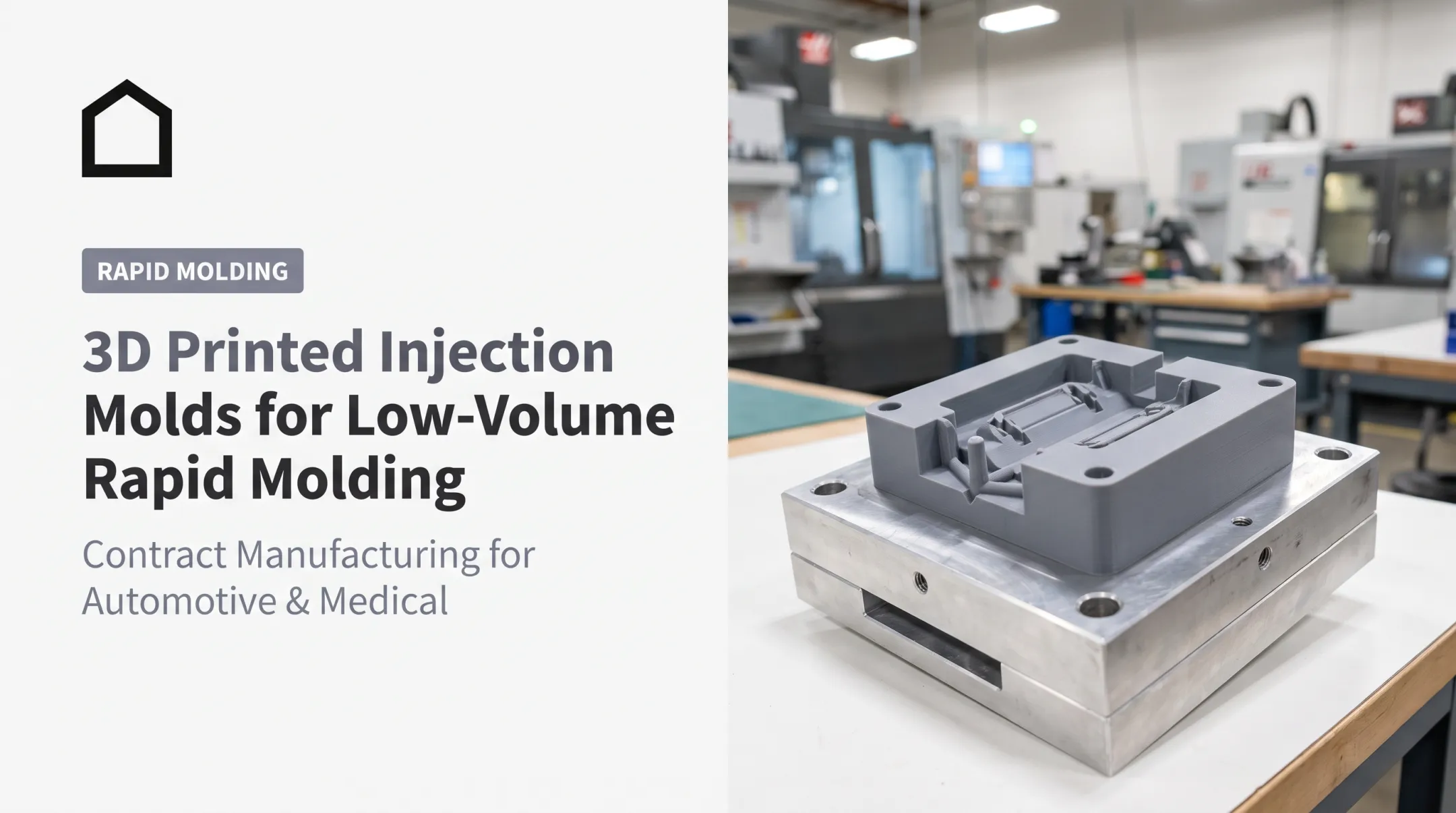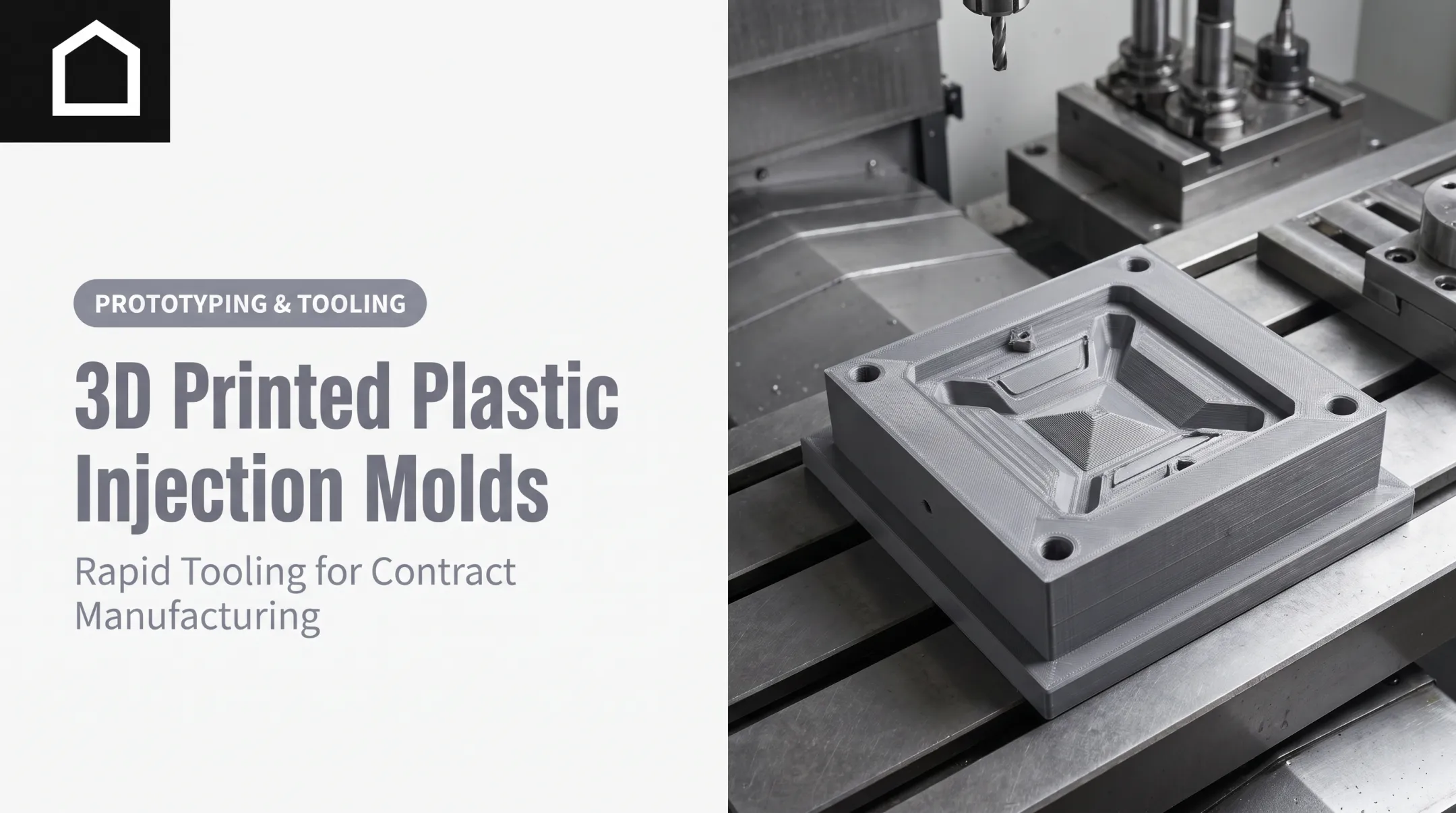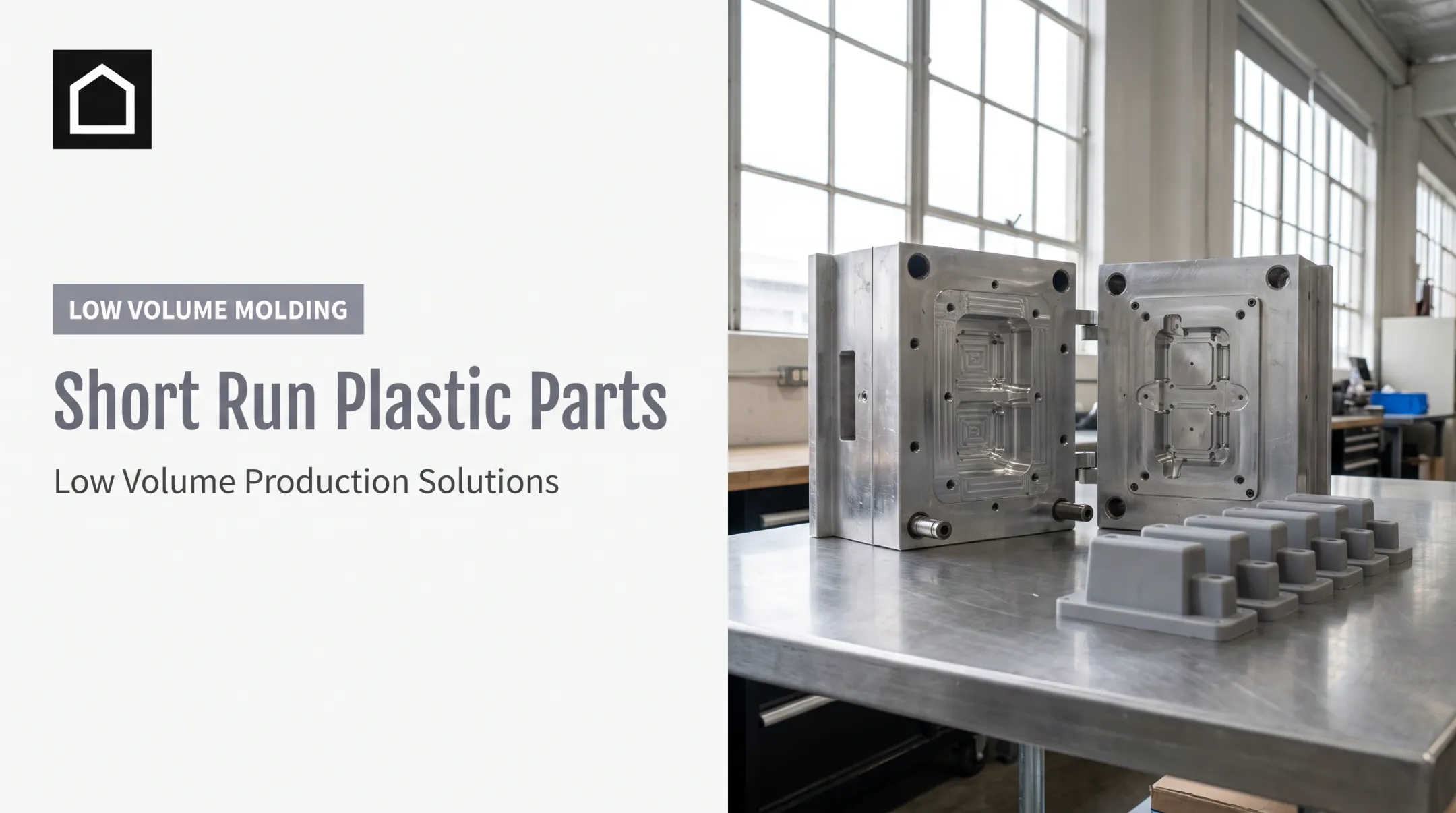

Bridge production fills that gap. It's the manufacturing strategy that lets teams validate designs, run clinical trials, and even ship early orders while permanent tooling is still being cut. Tight launch windows, cash flow constraints, and the risk of locking in a flawed design have made bridge strategies a standard part of product development rather than an afterthought.
This guide breaks down what bridge production actually means, compares the four major alternatives teams use to get there, and gives you a practical framework for choosing the right one for your part.
Key Takeaways
- Bridge production delivers production-grade parts before steel tooling is ready, cutting launch risk and delay.
- Four main alternatives: rapid aluminum tooling, cast urethane, industrial 3D printing, and CNC machining.
- Choose by volume, material fidelity, and lead time—not by method popularity.
- Aluminum tooling often runs 2,000–10,000+ shots—more flexible than fixed caps suggest.
- One partner across prototyping, bridge, and finishing cuts vendor handoffs and timeline risk.
What Is Bridge Production Injection Molding?
Bridge production injection molding is a low-to-medium volume manufacturing method used to make functional, often production-grade parts while permanent steel tooling is still being built. It sits between prototyping and mass production: parts are no longer just proof-of-concept, but the final tool isn't ready yet.
Think of it as a three-stage pipeline: Prototype → Bridge Production → Production. Each stage exists to de-risk the next.

Bridge production gets used across several points in a product's life:
- Pilot runs that validate assembly processes before committing to full-scale output
- Clinical or regulatory trials requiring parts made from certified, production-intent materials
- Early market testing where demand is still unproven and a $40,000 steel mold would be premature
Bridge production isn't only a stopgap until "real" tooling arrives. For many programs—especially medical and defense work where design changes continue after launch—it is the smarter long-term path.
Flexible bridge methods keep output moving as the design evolves:
- Aluminum bridge tooling for production-intent plastic parts without full steel cost
- Urethane casting for short runs while geometry is still changing
- One manufacturing partner across revisions, so you avoid scrapping a steel tool with every change
Why Is Bridge Production Important in Manufacturing?
Skipping bridge production and jumping straight to hardened steel tooling is one of the costliest mistakes a product team can make. Steel molds are unforgiving once cut. Change a wall thickness or add a boss after the fact, and you're often paying for a second tool.
Without a bridge strategy, three things tend to go wrong:
- Design flaws get discovered after $50,000+ in steel tooling is already committed
- Launch dates slip by months while a replacement tool is machined
- Early customer orders go unfulfilled because no interim parts exist
Bridge production solves these problems while protecting cash flow. Rather than front-loading your entire tooling budget before the design is final, you spread investment across stages:
- Interim tooling lets you validate design changes before committing to steel
- Real parts become available for regulatory testing, trade shows, or beta customers
- Full tooling investment waits until the design is locked
There's also a quality dimension. Aluminum-tooled bridge parts, for example, use the exact same production resin as your eventual steel-molded parts, so mechanical testing results hold up. That's a meaningfully different outcome than discovering, after certification testing, that your 3D-printed prototype doesn't represent how the injection-molded part will perform under load.

Types of Bridge Production Injection Molding Alternatives
Bridge production isn't one process. It's a category, and four methods dominate it. Each trades off tooling cost, lead time, material fidelity, and achievable volume differently, so the "right" choice depends entirely on your part's requirements.
Rapid Aluminum Tooling (Rapid Injection Molding)
Rapid aluminum tooling uses CNC-machined, semi-hardened aluminum (or sometimes soft steel) mold bases to run true injection molding with production-grade resins. Automated toolpath generation and modular mold bases mean a working tool can be built in days to a few weeks, not months. Core distinguishing factor: This is real injection molding physics—high pressure, production resin, and parts that match your eventual steel-tooled output in material and finish. Best suited for:
- Bridge runs between roughly 500 and 10,000 units
- Medical device, automotive, and consumer electronics programs needing certified resins
- Functional testing that requires true production-grade mechanical properties Key strengths:
- Production-grade materials with high dimensional precision and strong cosmetic finishes
- Tooling costs well below hardened steel
- Faster machining and better heat conduction than tool steel, which shortens tool-build and molding cycle time Trade-offs:
- Finite tool life: aluminum tools typically deliver somewhere between 2,000 guaranteed shots and 10,000+ cycles, depending on resin abrasiveness and part geometry—confirm the range with your toolmaker before committing
- Deep undercuts and sharp internal radii need added tooling complexity
Cast Urethane Molding (Vacuum Casting)
Cast urethane molding starts with a high-resolution 3D-printed or CNC-machined master model. That master creates a flexible silicone mold, into which liquid polyurethane resin is poured and cured under vacuum to eliminate air bubbles. Core distinguishing factor: No hard metal tooling. Soft silicone molds replicate the look and feel of injection-molded parts at a fraction of the tooling investment. Best suited for:
- Low-volume batches, generally 1 to 100 parts
- Marketing samples and pre-production validation units
- Large, complex enclosures where steel tooling isn't yet justified Key strengths:
- Very low upfront cost and excellent cosmetic surface replication
- Fast turnaround: a master and silicone mold can be ready in a day or two; full production-level orders usually take three to four weeks
- Wide range of durometer and elastomeric options Trade-offs:
- Silicone molds degrade after roughly 15 to 50 shots depending on geometry, so higher quantities need multiple mold replacements
- Cast polyurethane is a thermoset, not the injection resin it mimics—an "ABS-like" part looks and feels similar to ABS, but it isn't ABS, which matters when validation requires the real material
Industrial Additive Manufacturing (Direct 3D Printing)
Industrial 3D printing, including SLS, MJF, SLA, and FDM, builds functional polymer parts directly from CAD data, layer by layer, with zero tooling required. Core distinguishing factor: Completely tool-free. Geometric freedom that traditional mold extraction can't match, since there's no need to pull a part out of a cavity. Best suited for:
- Very low volumes, typically 1 to 50 parts, though some industrial SLS/MJF programs scale into the hundreds or thousands
- Highly customized or organic geometries
- Overnight design iterations during active development Key strengths:
- Zero tooling expense
- Instant design changes between print runs
- Distributed, on-demand production Trade-offs:
- SLS can show weaker properties along the Z-axis than the XY plane, so orientation matters for load-bearing parts
- MJF is more isotropic across directions; SLA yields a cured thermoset, not a thermoplastic
- Surface finish is distinct and often needs secondary work
- Cost-per-part climbs steeply at higher quantities
CNC Machining of Production Plastics
CNC plastic machining is subtractive: solid blocks of engineering plastic—such as PEEK, Delrin, ABS, or Nylon—get cut into finished parts on high-speed multi-axis mills. Core distinguishing factor: The tightest dimensional tolerances of any bridge method, with no mold and no thermal cure cycle. Best suited for:
- High-precision structural components
- Low-volume runs, roughly 5 to 100 parts
- Thick-walled geometries prone to sink marks if molded
- Specialized engineering plastics unavailable in cast or molded form Key strengths:
- Extreme accuracy and isotropic material integrity (unlike layer-based printing)
- No tooling lead time
- Compatibility with high-performance polymers Standard milling tolerance runs around ±0.005 in. without a drawing. Tighter tolerances near ±0.001 in. are achievable on select materials and features with a detailed spec. Trade-offs:
- Material waste and machine time drive per-part cost up quickly
- Internal hollow channels and complex undercuts are difficult or impossible to machine cost-effectively

How to Choose the Right Bridge Production Alternative
Picking a bridge method comes down to five practical questions, not whichever process is trendiest.
Purpose and Validation Goals
Ask what the parts actually need to prove:
- Cosmetic review or trade show samples: Cast urethane or printed parts usually suffice
- Drop testing and regulatory validation: Production-grade resin is typically required
- Production-intent builds: Aluminum tooling, or CNC machining for small counts
Production Volume and Scale
Rough volume bands to guide quoting:
- Under 50 parts: 3D printing or CNC machining
- 50 to 100 parts: Cast urethane molding
- 250 to 10,000 parts: Rapid aluminum tooling
These aren't fixed rules. One Formlabs case study on a mixer latch part found the crossover point between printing and molding at 13,050 units for that specific geometry. Always request a quote based on your actual part, not a generic chart.

Material and Mechanical Specifications
Match the process to the material requirement, not just the look of the part:
- Certified production resin, isotropic strength, or biocompatibility: Aluminum tooling or CNC machining
- Feel and appearance only: Cast urethane or SLA can approximate the resin
- True material substitution: Thermoset urethane and SLA parts are not a stand-in when the spec calls for production resin
Budget and Per-Unit Economics
Compare total cost, not just sticker price on the tool:
| Method | Upfront Cost | Per-Part Cost Trend |
|---|---|---|
| 3D Printing / CNC | Lowest | Rises quickly at volume |
| Cast Urethane | Low | Moderate, mold replacement adds cost |
| Aluminum Tooling | Moderate | Low per-part, amortizes well |
Lead Time and Full-Service Partner Integration
Immediate urgency (days) favors printing or CNC. Short tooling lead times of one to three weeks fit urethane or aluminum tooling.
One partner across CAD refinement, prototyping, bridge tooling, and finishing cuts handoff delays. Finine Design and Manufacturing runs that path as a Prototype → Bridge Production → Production workflow, so teams avoid switching vendors at each stage.
What to Check Before Finalizing a Bridge Production Alternative
A few oversights show up repeatedly in bridge production planning. Check these before you commit:
- Overbuilding the solution. Don't specify aluminum tooling when CNC machining or casting fulfills the project goals for a few dozen parts.
- Ignoring material limits. Non-molded materials (cast thermosets, printed photopolymers) have different thermal and mechanical ceilings than your final production resin.
- Missing the cost inflection point. Low-volume methods get expensive fast. Beyond a certain quantity, cumulative per-part costs exceed what a dedicated aluminum tool would have cost.
- Skipping design-for-manufacturability (DFM). Settle draft angles, wall thickness, gate placement, and parting lines early so the part moves into steel tooling cleanly—not redesigned from scratch.
- Forgetting finishing costs. Painting, texture matching, labeling, and assembly affect total cost and timeline—plan them before parts are molded, not after.
Conclusion
Bridge production exists because launching a new product shouldn't require betting your entire tooling budget before the design is proven. Rapid aluminum tooling, cast urethane molding, industrial 3D printing, and CNC machining each solve a different piece of that problem, depending on your volume, material requirements, and timeline.
Match the method to the part, not the other way around. A part needing certified production resin at 2,000 units has a different answer than a cosmetic sample needed in three days.
If you're weighing these options for an upcoming launch, Finine Design and Manufacturing handles CAD review, bridge tooling, and finishing under one roof. Your part can move from concept to production without losing momentum between vendors.
Reach Jaime at Jaime@fi9design.com or 1.858.900-9787 to map the right path for your next build.
Frequently Asked Questions
What are some alternatives to injection molding for small projects?
The main cost-effective options for low-quantity runs are 3D printing, cast urethane molding, and CNC machining. Each avoids hard tooling costs while still producing functional, testable parts.
Can HDPE be injection molded?
Yes. HDPE is a widely used injection molding resin, common in closures, crates, and totes, valued for its chemical resistance and toughness. It molds predictably with standard processing parameters.
What are the newest technologies in injection molding?
Recent developments include Freeform Injection Molding using dissolvable 3D-printed tooling and all-electric molding presses with faster setup. AI-driven process monitoring now tracks over 1,000 parameters in real time, alongside new bio-based resin options.
What are the three types of molding?
The three fundamental industrial molding processes are injection molding, compression molding, and blow molding. Each shapes plastic differently: forced injection, heat-and-pressure compression, and air-expanded hollow forming.
What is the typical lifespan of bridge tooling compared to production steel molds?
Aluminum bridge tools typically last between 2,000 and 10,000+ shots depending on resin and geometry. Hardened steel production molds, by comparison, are rated for 100,000 up to over 1,000,000 shots.
When should a project transition from bridge production to high-volume injection molding?
Transition once the part design is locked, demand is validated through real orders, and projected volumes justify hardened steel tooling costs. Moving too early risks paying for design changes twice.